

Artificial Intelligence isn’t just one single technology — it’s an umbrella term that covers many different types, each with its own capabilities and use cases. If you’ve ever wondered why a chatbot feels different from a self-driving car’s AI, or how machine learning relates to deep learning, this guide will clear things up.
In this article, we’ll break down the different types of Artificial Intelligence in simple, easy-to-understand language, so you know exactly what each one means and where you’ve probably already encountered it.
Why Understanding AI Types Matters
Before diving in, it helps to know why this classification exists. AI can be categorized in two main ways:
- By capability – how intelligent or human-like the AI is
- By functionality – how the AI processes information and makes decisions
Let’s explore both categories in detail.
AI Types Based on Capability
1. Narrow AI (Weak AI)
Narrow AI, also called Weak AI, is designed to perform a single specific task really well. It cannot think beyond what it’s programmed or trained to do.
Examples:
- Voice assistants like Siri and Alexa
- Recommendation engines on Netflix or Amazon
- Spam filters in your email
- Face recognition on smartphones
This is the only type of AI that exists in the real world today. Despite sounding “basic,” Narrow AI powers almost every AI application we use daily.
2. General AI (Strong AI)
General AI refers to a machine that could understand, learn, and apply intelligence across any task — just like a human being. It would be able to reason, plan, and solve unfamiliar problems without being specifically trained for them.
Current status: General AI does not exist yet. It remains a theoretical concept and an active area of research.
3. Super AI
Super AI is a hypothetical future stage where machine intelligence would surpass human intelligence in every aspect — creativity, problem-solving, emotional understanding, and decision-making.
Current status: Purely theoretical and often discussed in the context of long-term AI safety and ethics.
AI Types Based on Functionality
4. Reactive Machines
The most basic form of AI. These systems respond to specific inputs with fixed outputs but have no memory of past experiences.
Example: IBM’s Deep Blue, the chess-playing AI that defeated a world champion — it analyzed moves in real time without learning from previous games.
5. Limited Memory AI
This type can use past data to inform current decisions. Most modern AI applications fall into this category.
Example: Self-driving cars that use recent data (like the speed of nearby vehicles) to make driving decisions.
6. Theory of Mind AI
A more advanced, still largely theoretical type of AI that would be able to understand emotions, beliefs, and intentions — similar to how humans understand one another.
Current status: Still in early research stages.
7. Self-Aware AI
The most advanced and entirely hypothetical type of AI, which would possess self-awareness and consciousness. This exists only in theory and science fiction for now.
AI Types Based on Technique
Beyond capability and functionality, AI is also categorized by the methods used to build it:
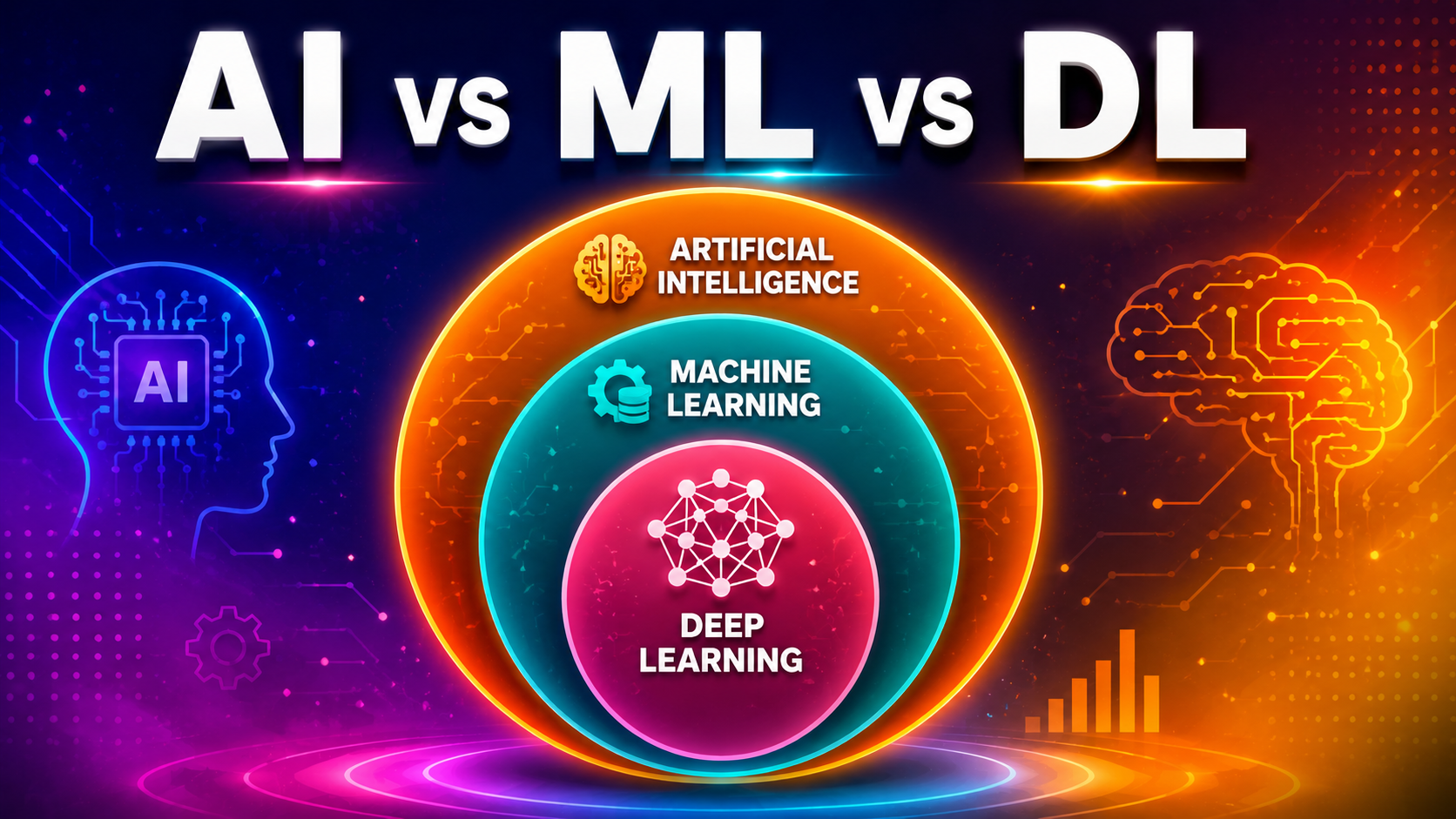
8. Machine Learning (ML)
Machine Learning is a method where systems learn from data rather than following fixed rules. The more data it processes, the better it performs.
Example: Email spam filters that improve over time based on what users mark as spam.
9. Deep Learning
A specialized subset of machine learning that uses layered neural networks inspired by the human brain. It’s especially powerful for complex tasks like image and speech recognition.
Example: Facial recognition systems used for phone unlocking or security.
10. Natural Language Processing (NLP)
NLP allows machines to understand, interpret, and generate human language.
Example: Translation tools, grammar checkers, and chatbots.
11. Generative AI
One of the most talked-about AI types today, Generative AI can create new content — text, images, music, or code — based on patterns learned from massive datasets.
Example: AI writing assistants and AI image-generation tools.
12. Computer Vision
This type of AI enables machines to interpret and understand visual information from the world, like images and videos.
Example: Medical imaging AI that detects abnormalities in X-rays.
Quick Comparison Table
| AI Type | Current Status | Example |
|---|---|---|
| Narrow AI | Exists today | Siri, Netflix recommendations |
| General AI | Theoretical | Not yet developed |
| Super AI | Hypothetical | Not yet developed |
| Reactive Machines | Exists today | Deep Blue |
| Limited Memory AI | Exists today | Self-driving cars |
| Theory of Mind AI | Research stage | Not yet developed |
| Self-Aware AI | Hypothetical | Science fiction |
| Machine Learning | Exists today | Spam filters |
| Deep Learning | Exists today | Face recognition |
| Generative AI | Exists today | AI writing/image tools |
Which Type of AI Do We Use Today?
Almost all AI applications we interact with — from voice assistants to recommendation systems — fall under Narrow AI, often powered by Machine Learning, Deep Learning, or Generative AI techniques. General AI and Super AI remain concepts for the future, discussed more in research and popular culture than in real-world products.
Final Thoughts
Understanding the different types of Artificial Intelligence helps demystify the technology shaping our world. While it might seem like AI is a single, all-knowing system, in reality it’s a collection of specialized tools — each designed for a specific purpose. As AI research advances, the line between these categories may continue to evolve, but for now, Narrow AI remains the driving force behind everyday innovation.
Frequently Asked Questions (FAQs)
Q1: What are the 3 main types of AI? The three main types based on capability are Narrow AI, General AI, and Super AI. Currently, only Narrow AI exists in practical use.
Q2: What is the difference between Narrow AI and General AI? Narrow AI is designed for a specific task, while General AI would theoretically perform any intellectual task a human can — but General AI doesn’t exist yet.
Q3: Is ChatGPT a type of Narrow AI or General AI? Tools like AI chatbots are considered advanced Narrow AI, since they specialize in language-based tasks, even though they can handle a wide range of topics.
Q4: What is the difference between Machine Learning and Deep Learning? Machine Learning is a broader method where systems learn from data, while Deep Learning is a specialized subset of ML that uses neural networks for more complex tasks.
Q5: Does Super AI exist today? No, Super AI is entirely hypothetical and is often discussed in the context of future AI safety and ethics research.