

How Does ChatGPT Work? A Simple Breakdown for Everyone
Meta Title: How Does ChatGPT Work? A Simple Breakdown (2026 Guide) Meta Description: Curious how ChatGPT generates human-like answers? This guide breaks down how ChatGPT actually works — in simple, practical language anyone can understand. Focus Keyword: How does ChatGPT work Secondary Keywords: ChatGPT explained, how ChatGPT generates text, ChatGPT AI model, large language model explained, ChatGPT working process
Ask ChatGPT to write a poem, debug your code, or explain quantum physics, and within seconds, you get a surprisingly coherent answer. It almost feels like magic. But behind that smooth conversation is a fascinating mix of math, data, and engineering.
If you’ve ever wondered how does ChatGPT actually work? — this guide will walk you through it step by step, without drowning you in technical jargon.
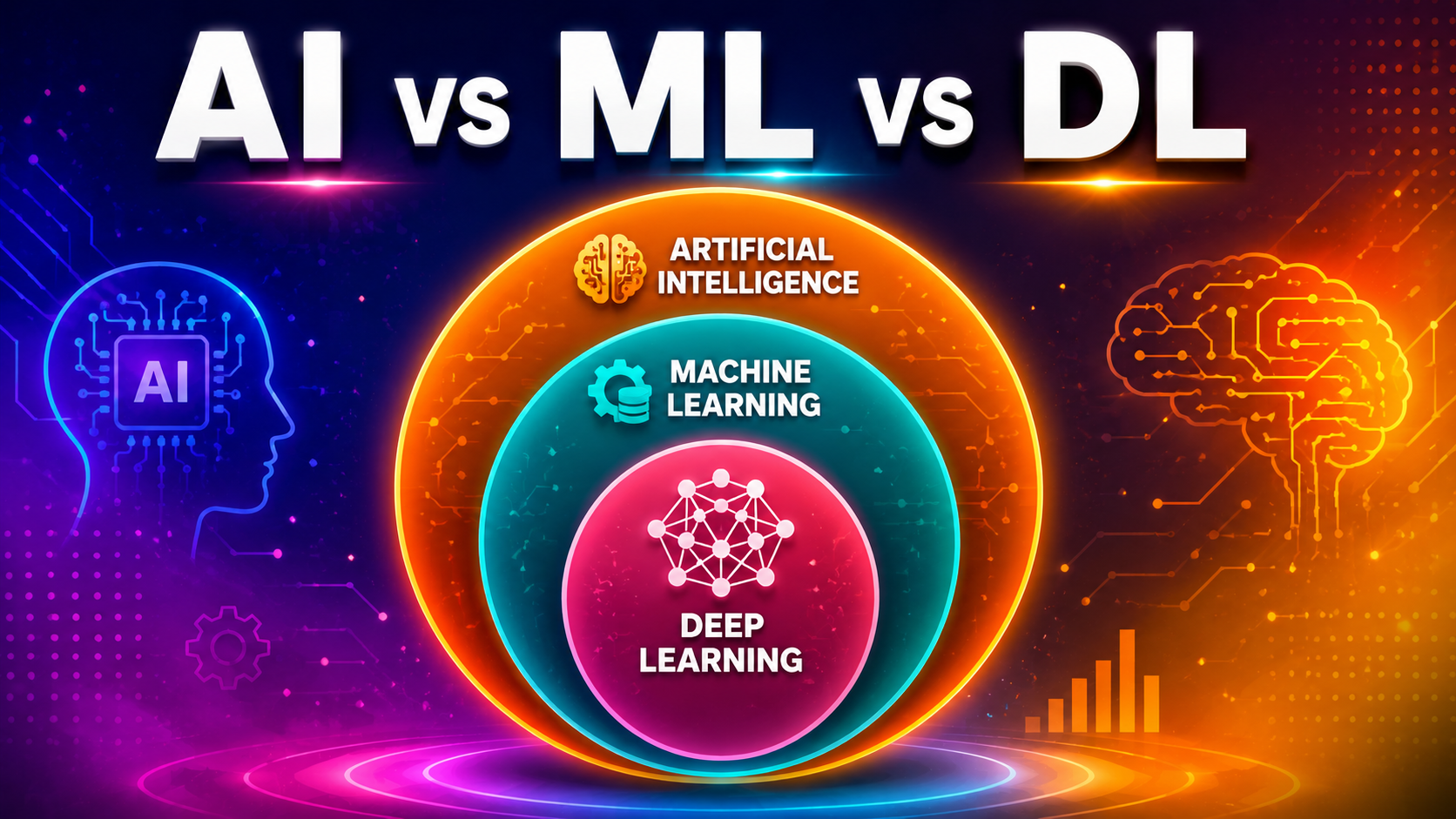
If you’re new to the broader topic, it also helps to first understand what Artificial Intelligence is and the different types of AI, since ChatGPT is built on specific AI techniques covered in those guides.
What is ChatGPT, Exactly?
ChatGPT is a type of Generative AI — a system that produces new content (in this case, text) based on patterns it has learned from massive amounts of data. It belongs to a category of models called Large Language Models (LLMs), which are trained specifically to understand and generate human language.
In simple terms, ChatGPT doesn’t “know” facts the way a search engine does. Instead, it predicts what word (or part of a word) is most likely to come next in a sentence, based on everything it has learned during training.
The Core Idea: Predicting the Next Word
At its heart, ChatGPT works by answering one repeated question: “Given everything so far, what’s the most likely next word?”
Practical Example: If you type: “The capital of France is”, ChatGPT predicts the next word is likely “Paris” — not because it looked it up, but because it has seen this pattern countless times during training.
It repeats this word-by-word prediction process extremely fast, building full sentences, paragraphs, and even code this way.
How ChatGPT Was Built: Step by Step
Here’s a simplified breakdown of the process behind ChatGPT:
| Step | What Happens | Purpose |
|---|---|---|
| 1. Data Collection | Massive amounts of text (books, articles, websites) are gathered | Gives the model a broad understanding of language |
| 2. Pre-training | The model learns patterns, grammar, and facts by predicting text | Builds the model’s core language ability |
| 3. Fine-tuning | The model is trained further using curated, high-quality examples | Improves accuracy and usefulness |
| 4. Human Feedback (RLHF) | Human reviewers rate responses to guide better behavior | Makes responses safer and more helpful |
| 5. Deployment | The trained model is made available through an app or API | Allows users to interact with it |
This entire pipeline is what allows ChatGPT to hold a conversation that feels natural and relevant.
The Technology Behind ChatGPT: The Transformer
ChatGPT is built on something called a Transformer architecture — a breakthrough AI design introduced in 2017 that changed how machines process language.
Here’s what makes transformers special, in simple terms:
- Attention Mechanism: The model looks at all the words in a sentence at once and decides which ones matter most to understand the meaning — rather than reading word-by-word like older models did.
- Context Handling: This allows ChatGPT to understand relationships between words even if they’re far apart in a sentence.
- Parallel Processing: Transformers can process large chunks of text simultaneously, making them much faster to train than older AI models.
This is also where ChatGPT connects to concepts like Deep Learning and Natural Language Processing, which we explained in our guide on types of AI.
Practical Example: How ChatGPT Answers a Question
Let’s say you ask: “What are the benefits of exercise?”
Here’s what happens behind the scenes:
- Your input is broken down into smaller units called tokens (roughly word pieces)
- The model analyzes the relationship between these tokens using its trained knowledge
- It predicts the most likely next token, then the next, and so on
- This continues until it forms a complete, coherent response
- The final response is displayed to you as natural-sounding text
This entire process happens in a few seconds, even though it involves billions of internal calculations.
What ChatGPT Can and Cannot Do
ChatGPT is good at:
- Answering general knowledge questions
- Writing and editing content
- Explaining complex topics simply
- Helping with code and debugging
- Brainstorming ideas
ChatGPT has limitations:
- It can occasionally generate incorrect information (sometimes called “hallucination”)
- It doesn’t have real-time awareness unless connected to external tools
- It doesn’t truly “understand” like a human — it recognizes patterns
- Its knowledge is based on the data it was trained on, which has a cutoff point
Why ChatGPT Feels So Human-Like
ChatGPT’s responses feel natural because of how it was fine-tuned using human feedback. During training, real people reviewed thousands of responses and rated them based on helpfulness, clarity, and tone. This feedback loop taught the model to prefer natural, conversational phrasing over robotic or overly technical answers.
Final Thoughts
ChatGPT might feel like it’s “thinking,” but it’s really performing an extremely sophisticated form of pattern prediction, built on massive datasets and refined through human feedback. Understanding this process helps demystify the technology — it’s not magic, but a remarkable application of the AI concepts we covered in our earlier guides on what AI is and the different types of AI.
As AI models continue to evolve, the underlying principle remains the same: predicting patterns in data to generate useful, human-like responses.
Frequently Asked Questions (FAQs)
Q1: Does ChatGPT actually understand language like humans do? No. ChatGPT recognizes patterns in language based on its training data rather than truly understanding meaning the way humans do.
Q2: What is a Large Language Model (LLM)? An LLM is a type of AI model trained on massive amounts of text to understand and generate human-like language, and ChatGPT is one example of an LLM.
Q3: Why does ChatGPT sometimes give wrong answers? Since ChatGPT predicts likely text patterns rather than verifying facts, it can occasionally generate inaccurate information, a phenomenon known as “hallucination.”
Q4: What is the Transformer architecture in simple terms? It’s the underlying AI design that allows ChatGPT to understand relationships between words in a sentence, enabling it to generate coherent and context-aware responses.
Q5: Is ChatGPT a type of Narrow AI or General AI? ChatGPT is considered an advanced form of Narrow AI, since it specializes in language-based tasks, even though it can handle a wide variety of topics.