

“AI,” “Machine Learning,” and “Deep Learning” are three of the most commonly used — and most commonly confused — terms in tech today. People often use them interchangeably, but they actually mean different things.
If you’ve ever wondered whether they’re the same thing or how they relate to each other, this guide will clear up the confusion once and for all, using simple explanations and practical examples.
If you haven’t already, it helps to start with our beginner guide on what Artificial Intelligence is and our breakdown of the different types of AI, since Machine Learning and Deep Learning are both categories within that broader AI framework.
The Simplest Way to Understand the Relationship
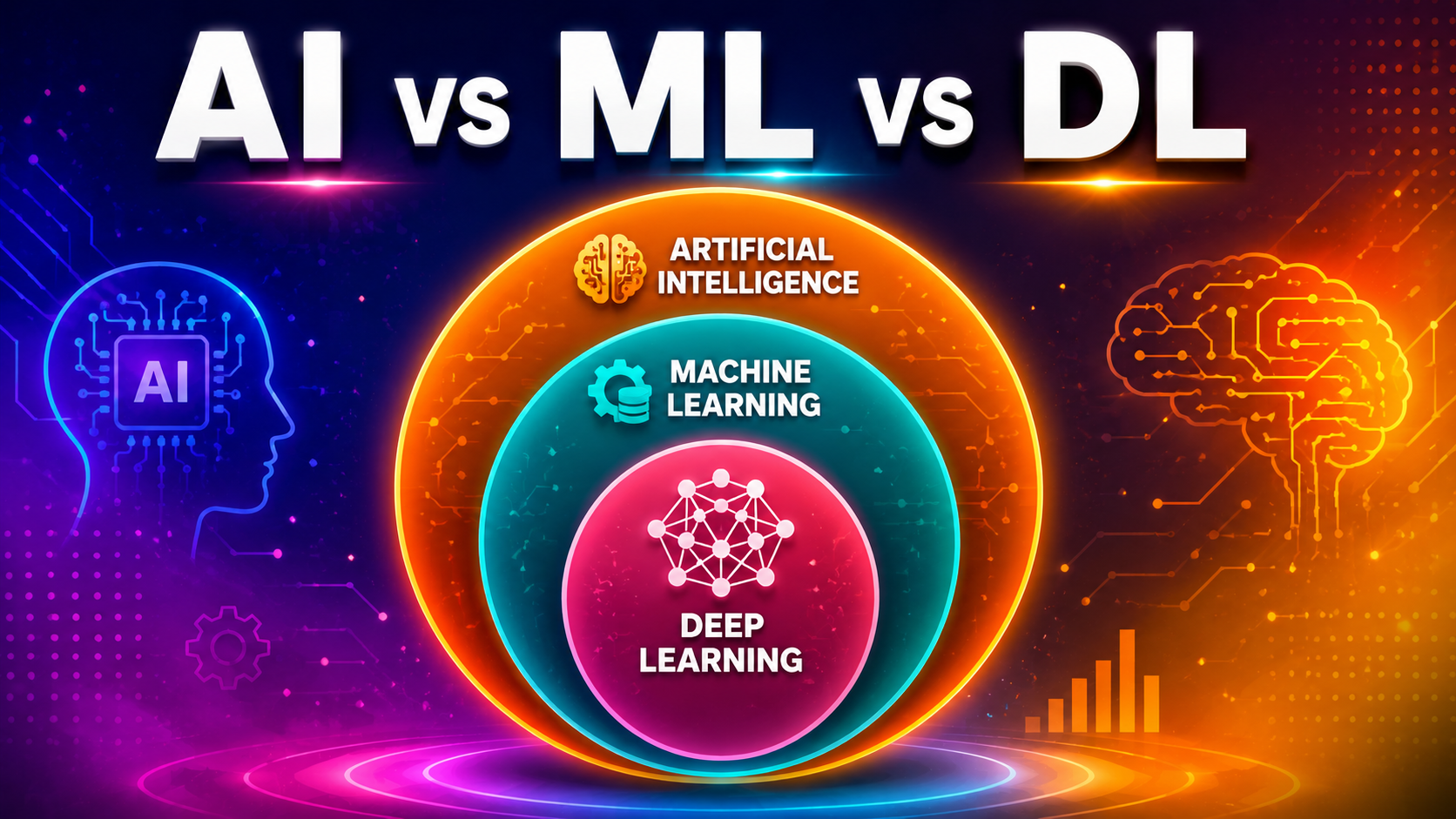
Think of it like a set of nested circles:
- Artificial Intelligence (AI) is the biggest circle — the overall concept of machines simulating human intelligence.
- Machine Learning (ML) is a smaller circle inside AI — a specific approach where machines learn from data.
- Deep Learning (DL) is an even smaller circle inside Machine Learning — a specialized technique using neural networks.
In short: Deep Learning is a subset of Machine Learning, and Machine Learning is a subset of AI.
What is Artificial Intelligence (AI)?
AI is the broad field focused on building machines that can perform tasks requiring human-like intelligence — things like understanding language, recognizing images, or making decisions.
AI includes many different techniques and approaches, not just Machine Learning. Rule-based systems (where a machine follows fixed “if-this-then-that” logic) are also a form of AI, even without any learning involved.
Example: A basic chatbot that only replies with pre-written answers based on keyword matching is technically AI — even though it doesn’t “learn” anything.
What is Machine Learning (ML)?
Machine Learning is a specific approach to AI where systems learn patterns from data instead of following fixed, manually written rules. Instead of programming every possible scenario, you feed the system data, and it learns to make predictions or decisions on its own.
Example: An email spam filter that improves over time, based on which emails users mark as spam, is a classic example of Machine Learning in action.
Key Characteristics of Machine Learning:
- Learns from historical data
- Improves accuracy with more data over time
- Works well for structured data like spreadsheets or numerical patterns
- Requires some manual feature selection (telling the model what factors matter)
What is Deep Learning (DL)?
Deep Learning is a specialized subset of Machine Learning that uses layered structures called neural networks, loosely inspired by how the human brain processes information. These networks have multiple “layers” that allow the system to automatically detect complex patterns, without needing humans to manually point out what to look for.
Example: Facial recognition on your smartphone uses Deep Learning to analyze thousands of tiny facial features and accurately identify a face, even in different lighting conditions.
Key Characteristics of Deep Learning:
- Uses multi-layered neural networks
- Requires much larger datasets than traditional Machine Learning
- Automatically detects patterns without manual feature selection
- Powers advanced applications like image recognition, voice assistants, and generative AI tools like ChatGPT
AI vs Machine Learning vs Deep Learning: Comparison Table
| Feature | Artificial Intelligence (AI) | Machine Learning (ML) | Deep Learning (DL) |
|---|---|---|---|
| Definition | Broad field of machine intelligence | Subset of AI that learns from data | Subset of ML using neural networks |
| Data Requirement | Varies | Moderate | Very large datasets |
| Human Involvement | Can include fixed rules | Requires feature selection | Minimal manual feature input |
| Examples | Chatbots, robotics, expert systems | Spam filters, recommendation engines | Facial recognition, voice assistants, generative AI |
| Complexity | Ranges from simple to complex | Moderate complexity | High complexity |
Practical Example: Putting It All Together
Let’s say a company wants to build a system that recommends products to online shoppers.
- As AI: The overall goal — building an intelligent system that personalizes recommendations — falls under the AI umbrella.
- As Machine Learning: The company uses purchase history and browsing data to train a model that predicts what a customer might like.
- As Deep Learning: If the company wants to analyze product images or customer reviews in detail (like understanding sentiment in written feedback), they might use a deep learning model to process that unstructured data more accurately.
This example shows how all three concepts often work together, layered on top of each other, rather than being completely separate technologies.
Why This Distinction Matters
Understanding these differences isn’t just academic — it helps you:
- Make sense of tech news and product claims (not everything labeled “AI” involves complex learning)
- Choose the right approach if you’re exploring a career or project in AI
- Better understand tools like ChatGPT, which relies heavily on deep learning techniques
Final Thoughts
AI, Machine Learning, and Deep Learning aren’t competing technologies — they’re layered concepts, each building on the one before it. AI is the broad goal, Machine Learning is one major way to achieve it, and Deep Learning is a powerful, more advanced technique within Machine Learning. Understanding this hierarchy makes it much easier to follow AI news, evaluate new tools, and understand how modern technology actually works behind the scenes.
Frequently Asked Questions (FAQs)
Q1: Is Machine Learning the same as AI? No. Machine Learning is a subset of AI — AI is the broader concept, while Machine Learning refers specifically to systems that learn from data.
Q2: Is Deep Learning better than Machine Learning? Not necessarily “better” — Deep Learning is a specialized form of Machine Learning, best suited for complex tasks like image or speech recognition, while traditional Machine Learning works well for simpler, structured data problems.
Q3: Does all AI use Machine Learning? No. Some AI systems use fixed, rule-based logic without any learning involved, while others rely on Machine Learning to improve over time.
Q4: What is an example of Deep Learning in everyday life? Facial recognition on smartphones, voice assistants, and AI tools like ChatGPT all rely on Deep Learning techniques.
Q5: Do I need to know Machine Learning to understand Deep Learning? Having a basic understanding of Machine Learning concepts makes it easier to grasp Deep Learning, since Deep Learning builds directly on Machine Learning principles.