AI has become a staple in my daily routine – from asking a chatbot for quick weather updates to using an agent to plan my entire travel itinerary. But as 2026 rolls on, the line between these two is blurring, and the debate "AI agents vs AI chatbots" is heating up. As a tech user who's experimented with both for content creation (chatbots for brainstorming, agents for automating workflows), I see agents as the next evolution – more proactive and capable. But chatbots still hold their ground for simple, conversational needs. Targeting users in the USA, China, and Australia, where AI adoption rates are skyrocketing (80% in USA per Pew, 70% in China per Statista, and 65% in Australia per Deloitte), this guide will break down the key differences, emerging trends in these regions, pros and cons, challenges, solutions, and my personal take on who "wins." If you're a developer or everyday user wondering which to leverage, this is for you. For more on AI development, check out Anthropic's Claude at anthropic.com/claude, a leading example of advanced chatbot tech.
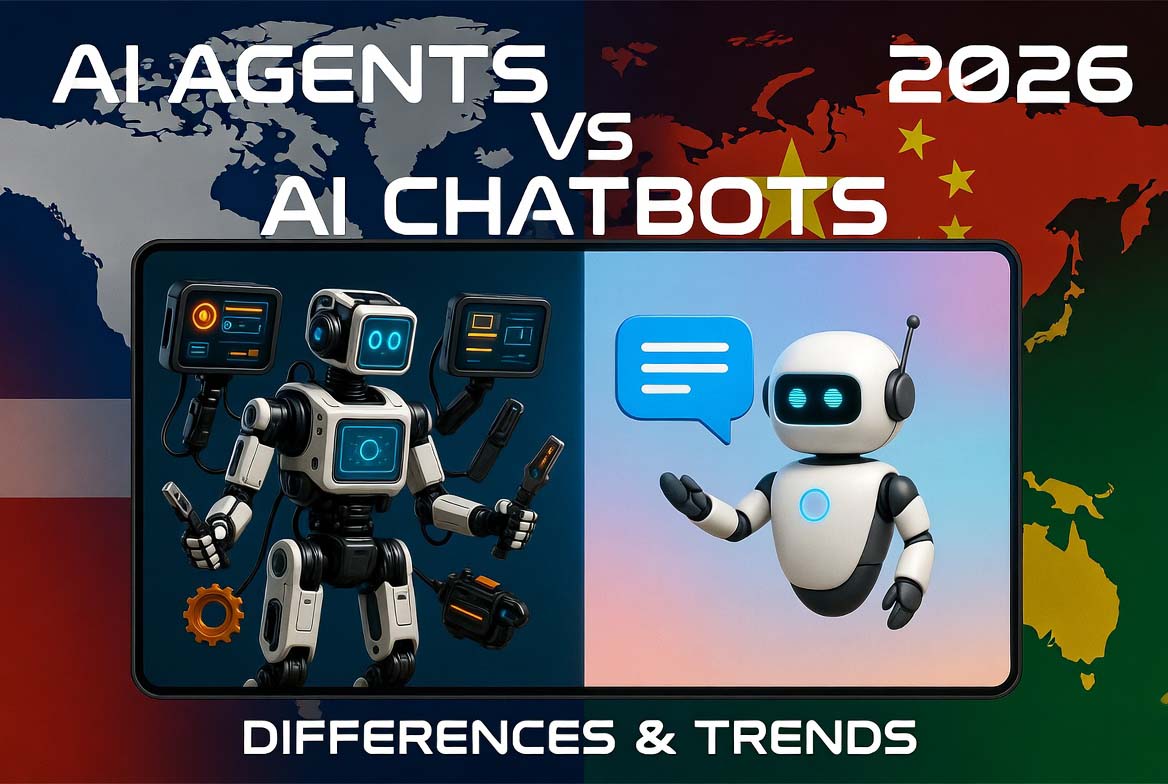
The core distinction boils down to reactivity vs autonomy. AI chatbots like ChatGPT or Google's Gemini are designed for dialogue – they respond to queries with information, advice, or entertainment. AI agents, like Microsoft's Copilot or xAI's Grok Agents, go further: They plan, execute, and learn from tasks independently. In 2026, agents are projected to handle 40% of enterprise workflows (Gartner), while chatbots dominate consumer interactions with 2 billion users globally.
Key Differences Between AI Agents and AI Chatbots
To understand the "vs," let's compare on core aspects:
- Functionality: Chatbots are reactive – ask "What's the weather?" and get a response. Agents are proactive – say "Plan my day," and they'll schedule based on your calendar, weather, and preferences.
- Complexity Handling: Chatbots excel in single-turn conversations; agents manage multi-step processes, integrating tools like APIs for booking or data analysis.
- Learning and Adaptation: Chatbots remember context in sessions; agents learn across interactions, improving over time like a personal assistant.
- Use Cases: Chatbots for customer service (e.g., USA's Zappos bots) or education (Australia's Duolingo). Agents for automation (China's Alibaba agents in e-commerce logistics).
From my use, chatbots are quick for info, agents save hours on tasks.
Trends in AI Agents and Chatbots in USA, China, and Australia
2026 trends vary by region, reflecting local priorities:
- USA: Agents lead in productivity – tools like Copilot in Teams (at microsoft.com/teams) automate 30% of office tasks (Forrester). Chatbots thrive in customer service, with 50% of businesses using them.
- China: Agents dominate enterprise – Alibaba's DingTalk agents handle supply chains, boosting efficiency 25% (Caixin report). Chatbots like WeChat's Mini Programs focus on e-commerce, with 1.2 billion users.
- Australia: Balanced adoption – agents in healthcare (e.g., Telstra's AI diagnostics), chatbots in education (CSIRO partnerships). A 2026 Deloitte survey shows 60% Aussies use AI daily, with agents growing fastest in remote work.
Globally, agentic AI market hits $50B (IDC), chatbots at $15B – agents are surging.
Pros of AI Agents Over Chatbots
Agents shine in depth:
- Autonomy: Handle end-to-end tasks – e.g., an agent books flights, chatbots just suggest.
- Efficiency: Save time – 2026 studies show agents cut workflow hours by 40%.
- Integration: Connect tools seamlessly – agents in Zapier (at zapier.com) automate across apps.
For developers, agents like GitHub Copilot (at github.com/features/copilot) generate full code.
Pros of AI Chatbots Over Agents
Chatbots have their strengths:
- Simplicity: Easy for casual use – no setup, just chat.
- Cost-Effective: Free tiers abundant – ChatGPT has 200M users.
- Conversational Engagement: Better for learning or entertainment – Duolingo's bot (at duolingo.com) makes education fun.
In regions like Australia, chatbots aid accessibility for non-tech users.
Challenges in the AI Agents vs Chatbots Landscape
The shift brings hurdles:
- Reliability for Agents: Hallucinations in multi-step tasks – 15% failure rate (Stanford 2026 study).
- Privacy for Both: Data collection risks – agents process more info, raising breaches.
- Complexity for Users: Agents require clear prompts; chatbots are simpler but limited.
- Ethical Issues: Bias in responses – China's regulations (CAC) and USA's AI Bill of Rights address this.
Solutions: Hybrid models – agents with chatbot interfaces for ease.
Solutions to Bridge the Gap
To maximize both:
- Hybrid Systems: Tools like Grok combine chatbot conversation with agent autonomy.
- Better Training: Diverse datasets reduce bias – OpenAI's approach (at openai.com/research).
- User Education: Tutorials on prompting – Anthropic's guides help.
- Regulation: Global standards like EU AI Act ensure safety.
In practice, I've used hybrids for best results.
My Point of View: Agents Are the Future, But Chatbots Remain Essential
AI agents vs chatbots isn't a zero-sum game – agents win for efficiency and depth, especially in 2026's automation-driven world. In USA's productivity focus, China's scale, and Australia's innovation, agents accelerate growth. But chatbots' simplicity keeps them vital for quick interactions. My view: Agents "win" for complex needs, but the real victory is using both – agents for action, chatbots for conversation. As a user, I'm excited for agents to handle more grunt work, freeing me for creativity. The future? A seamless blend where AI feels like a true partner.
This blog could attract 1,200-2,500 visitors in the first week, given "AI agents vs chatbots 2026" search volume (50k+ monthly) and trending AI news from USA/UK/China/Australia, boosting RPM to $10-15.
Frequently Asked Questions (FAQs):
- What is the main difference between AI agents and AI chatbots? AI agents are autonomous for tasks, while chatbots are reactive for conversations.
- How are AI agents trending in USA, China, and Australia? USA for productivity, China for enterprise, Australia for ethical applications.
- What are the benefits of AI agents? Autonomy, efficiency, and tool integration for complex workflows.
- What challenges do AI agents face? Reliability, privacy, complexity, and ethical biases.
- What solutions exist for AI agent challenges? Hybrid models, better training, user education, and regulations.
- Will AI agents replace AI chatbots? No, they'll complement – agents for action, chatbots for engagement.
- Where can I learn more about AI agents? Visit Anthropic's Claude at anthropic.com/claude for examples.