Introduction: The Dawn of a New AI Era
In the fast-evolving world of artificial intelligence, 2026 has marked a pivotal shift toward agentic systems – AI that doesn't just respond but acts autonomously, coordinates tasks, and solves complex problems in real-time. At the forefront of this transformation is Kimi 2.5, Moonshot AI's latest breakthrough. Released in January 2026, this open-source model isn't just another chatbot; it's a versatile powerhouse blending vision, language, and agentic capabilities. But Kimi 2.5 is more than a single innovation – it's a symbol of China's meteoric rise in AI, where domestic models are outpacing global competitors in efficiency, affordability, and practical applications. As Chinese AI agents dominate token usage on platforms like OpenRouter, capturing over 60% of global traffic, it's clear: the future of AI is being rewritten in Beijing and Shanghai.
What is Kimi 2.5? A Closer Look at Moonshot's Masterpiece
Moonshot AI, a Beijing-based startup, has been making waves since its founding, but Kimi 2.5 represents their most ambitious leap yet. Built on a Mixture-of-Experts (MoE) architecture with a staggering 1 trillion total parameters (activating 32 billion per request), this model was trained on 15 trillion mixed visual and text tokens. What sets it apart? Its native multimodality – the ability to process images, videos, and text seamlessly, enabling tasks like generating interactive UIs from natural language descriptions or debugging code via visual inputs.
Key highlights include:
- Ultra-Long Context Window: Supporting 256K tokens, Kimi 2.5 handles lengthy conversations and complex datasets without losing track.
- Breakthrough in Coding: As China's leading coding model, it excels in front-end development, creating functional interfaces with dynamic effects like animations – all from simple prompts.
- Visual Agentic Intelligence: Kimi 2.5 introduces "coding with vision," where it reasons over images or videos to produce code, making it ideal for visual debugging or replicating designs (e.g., mimicking Apple's web aesthetics from a screenshot).
- Operational Modes: It switches between instant responses, deep thinking, conversational chats, and full agentic tasks, offering flexibility for developers and enterprises.
Available via APIs on platforms like Hugging Face and Together AI, Kimi 2.5 is open-source, democratizing access while maintaining state-of-the-art (SoTA) performance on benchmarks like Humanity's Last Exam (50.2% with tools) and BrowseComp (78.4% with swarms). Priced affordably at $0.45/M input tokens, it's not just powerful – it's practical.
The Agent Swarm Paradigm: Kimi's Game-Changer
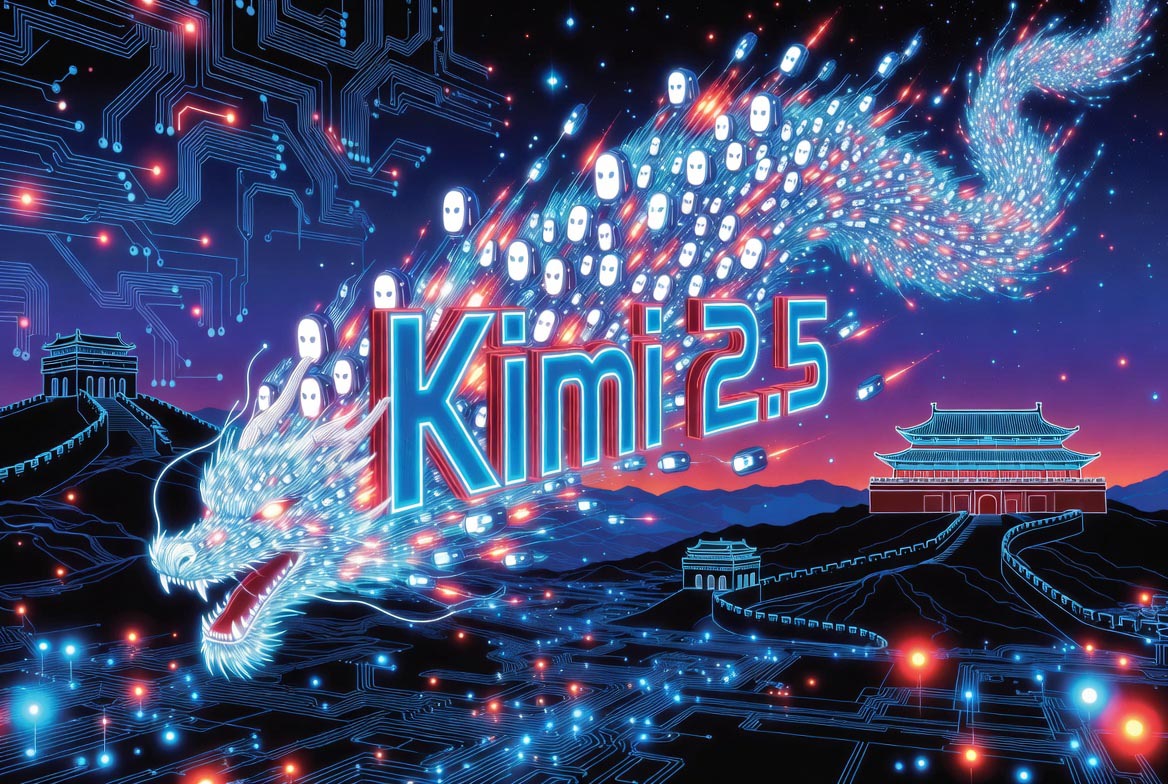
One of Kimi 2.5's standout features is its "Agent Swarm" technology, allowing up to 100 specialized AI agents to collaborate in parallel. Unlike traditional models that process tasks sequentially, this swarm approach slashes execution time by 4.5x and reduces costs by 76% compared to rivals like Claude Opus 4.5. Imagine assigning a research project: One agent gathers data, another analyzes visuals, a third codes prototypes – all coordinating autonomously.
This isn't hype; it's a paradigm shift. In tests, Agent Swarms have achieved SoTA on agentic benchmarks, handling long-horizon tasks with stable tool-use over 200-300 calls. For enterprises, this means automating workflows in coding, research, and even robotics, where efficiency is king.
The Broader Rise of Chinese AI Agents in 2026
Kimi 2.5 doesn't exist in isolation; it's part of a larger Chinese AI renaissance. Since DeepSeek's viral success in 2025, Chinese firms have flooded the market with competitive models. MiniMax M2.5 tops OpenRouter with 2.45 trillion tokens weekly (a 197% surge), while Zhipu AI's GLM-5 and Alibaba's Qwen3.5 excel in coding and agentic tasks. ByteDance's Seedance 2.0 and Kuaishou's Kling 3.0 push video generation, and Alibaba's RynnBrain targets physical AI like robotics.
Why the surge? Several factors:
- Cost Efficiency: Chinese models prioritize inference speed and low costs, making them "as cheap as electricity." This allows massive scaling for agents, outcompeting Western models on value.
- Open-Source Dominance: From Hugging Face to global developer communities, Chinese open models now lead downloads, with usage skyrocketing from 1.2% in 2024 to 30% in 2025.
- Agentic Focus: 2026 is the "year of AI agents," per experts like Gartner, who predict 40% of enterprise apps will embed them by year-end. Chinese firms are betting big, integrating agents into e-commerce, manufacturing, and even humanoid robots (e.g., XPeng's IRON).
- Global Adoption: Despite perceptions, models like Kimi are production-ready, powering tools on Google Cloud and Microsoft Foundry. Western devs are "sleeping on these," leaving money on the table.
This boom has geopolitical implications. As Sam Altman notes, Chinese progress is "remarkable," closing the gap with U.S. leaders. Predictions for 2026 include multi-agent orchestration in enterprises and humanoid robots scaling to thousands of units.
Implications and Challenges Ahead
The rise of Kimi 2.5 and Chinese AI agents promises transformative benefits: faster innovation, lower barriers for startups, and AI that's accessible worldwide. However, challenges loom – from ethical concerns (e.g., reliability in lethal decisions) to regulatory scrutiny, as seen in Meta's acquisition of Chinese firm Manus triggering Beijing's review.
For businesses, the message is clear: Integrate agentic AI now or risk falling behind. Tools like Kimi could replace outsourced coding, automate R&D, and enhance physical AI in sectors like manufacturing.
Conclusion: China's AI Agents Are Here to Stay
Kimi 2.5 isn't just a model; it's a beacon of China's AI ambitions, blending cutting-edge tech with practical efficiency. As agent swarms and multimodal intelligence become standard, 2026 will solidify China's role as a global AI powerhouse. Whether you're a developer eyeing new tools or a strategist watching the tech race, one thing's certain: The era of Chinese AI agents has arrived, and it's reshaping our world.
Frequently Asked Questions (FAQs)
- What is Kimi 2.5? Kimi 2.5 is an open-source multimodal AI model from Moonshot AI, featuring 1T parameters, 256K context, and strengths in coding, vision, and agentic tasks.
- How does Kimi 2.5's Agent Swarm work? Agent Swarm coordinates up to 100 specialized AI agents for parallel task execution, reducing time by 4.5x and costs significantly compared to sequential models.
- Why is Chinese AI rising so fast in 2026? Factors include cost-efficient designs, open-source focus, and emphasis on agentic capabilities, leading to dominance in global token usage and benchmarks.
- How does Kimi 2.5 compare to Western models like Claude or GPT? It leads in agentic benchmarks (e.g., 50.2% on Humanity's Last Exam) and vision-coding, often at lower costs, though Western models may edge out in general reasoning.
- Can I use Kimi 2.5 for free? Yes, it's open-source and accessible via APIs on platforms like Hugging Face, with affordable pricing for advanced usage.
- What are the applications of Chinese AI agents? They automate workflows in coding, research, robotics, e-commerce, and more, with predictions of widespread enterprise adoption by end-2026.
- Is Kimi 2.5 suitable for beginners? While powerful for developers, its APIs and tools make it approachable for tasks like code generation or visual analysis, even for non-experts.
- What challenges do Chinese AI models face globally? Perceptions of trustworthiness, regulatory hurdles, and competition from U.S. firms, though their efficiency is driving rapid adoption.
- How is AI agent technology evolving in 2026? From single agents to multi-agent systems, with a focus on real-world tasks like supply chain optimization and humanoid robotics.
- Where can I learn more about Kimi 2.5? Check Moonshot AI's official docs, Hugging Face repo, or benchmarks on sites like OpenRouter for hands-on insights.