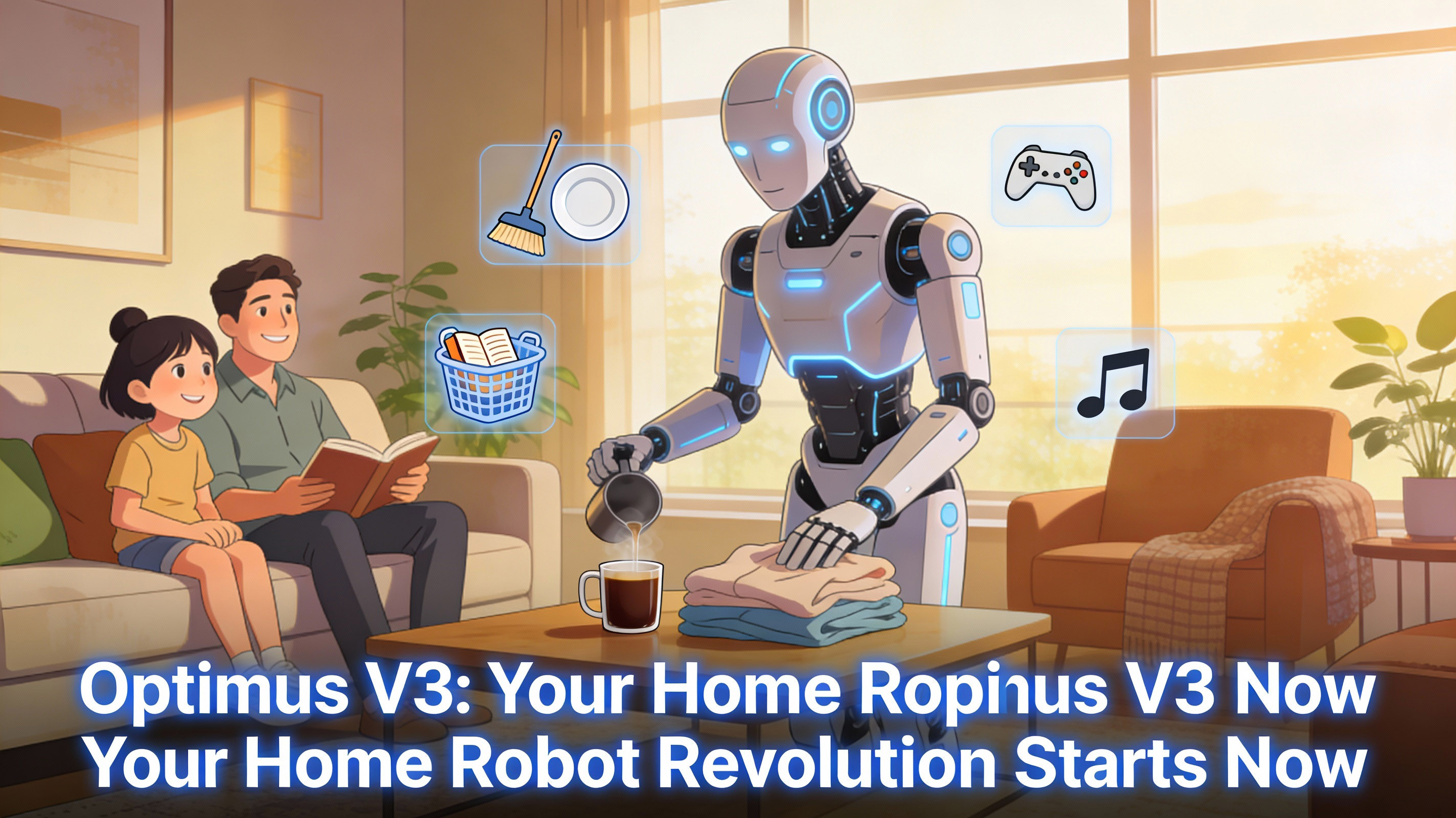
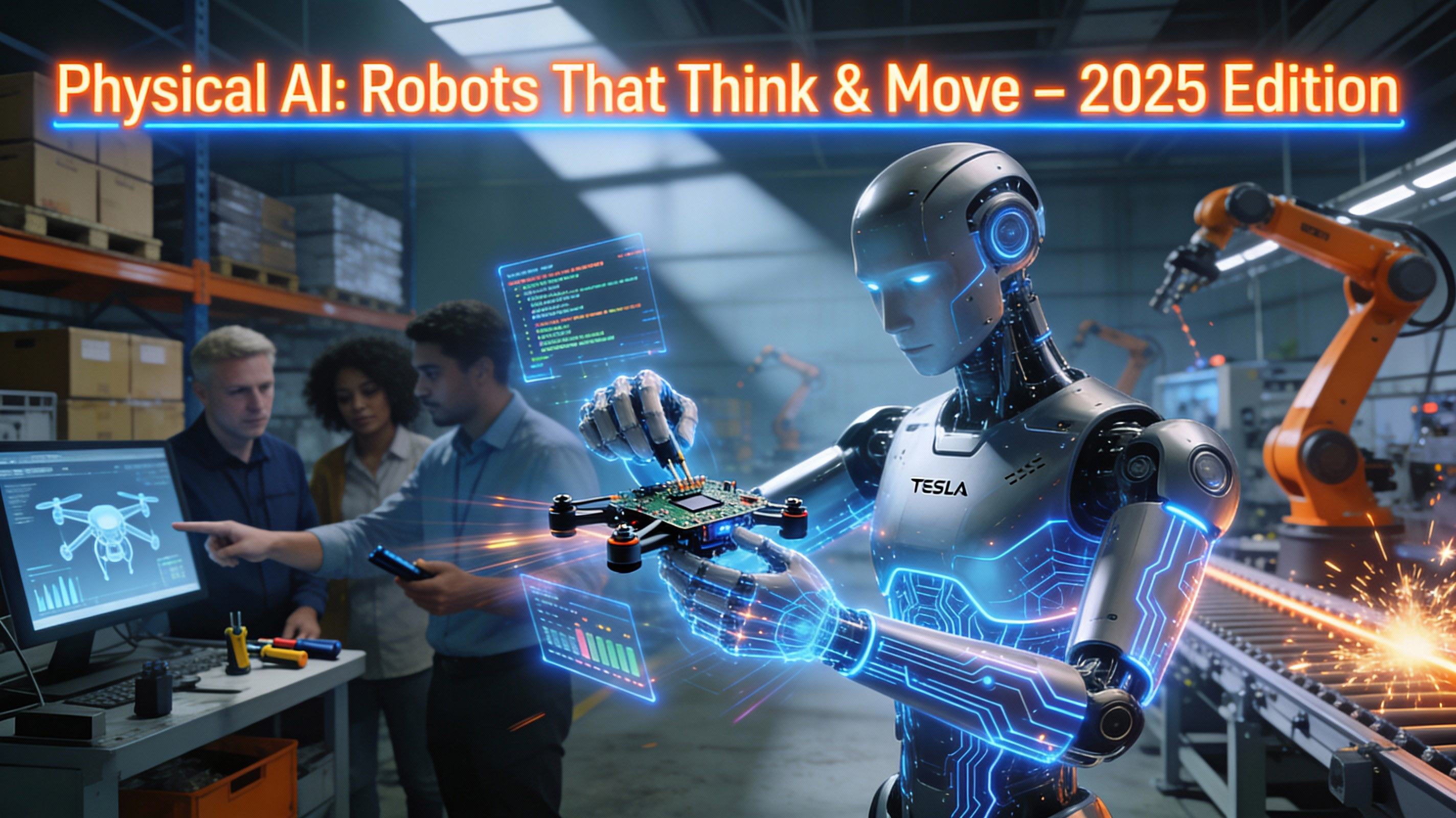
Yo, what's good? Alex here, back at it with another tech rabbit hole—because who needs sleep when there's a robot army brewing? If 2025's been the year of AI chatting up your grandma via voice mode, then Physical AI is the plot twist: It's AI stepping out of the screen and into steel and silicon, making robots not just move, but think like us in the messy real world. Picture Optimus folding your laundry or a bot surgeon nailing a tricky stitch—sounds like Black Mirror? Nah, it's Tuesday for the trailblazers.
I've been knee-deep in this since NVIDIA's keynote had me yelling at my monitor (in a good way), and let me tell you: Physical AI isn't some far-off dream. With $16B poured into startups this year alone, it's exploding from labs to logistics. In this post, we'll unpack what it is (spoiler: less Terminator, more helpful roommate), how it ticks, 2025's wild wins, real-talk examples, the hype vs. hurdles, and why 2026 might be when bots crash your couch. No engineering degree needed—just curiosity and maybe a side-eye at Elon. Let's roll.
What the Heck is Physical AI? (And Why It's Not Just "Smart Robots")
Straight up: Physical AI is AI with a body. While "digital AI" (think ChatGPT brainstorming your next tattoo) crunches data in the cloud, Physical AI wires that smarts into hardware that interacts with our 3D chaos—perceiving obstacles, planning grabs, and acting without you yelling "abort!" every five seconds. It's the bridge from bits to atoms: Robots that learn from trial-and-error, adapt to spills or surprises, and scale from warehouses to wards.
Analogy time: Classical robots are like that rigid Roomba—great at vacuuming, dumb at stairs. Physical AI? It's Roomba on steroids, using vision-language-action (VLA) models to "see" a toy, "understand" it's in the way, and gently nudge it aside. Key ingredients? Multimodal AI (mixing cameras, sensors, touch), edge computing (brains on-board, not laggy cloud pings), and foundation models trained on zillions of sim hours. Deloitte calls it the "convergence" era: AI + robotics = a $50T shakeup in manufacturing and beyond.
I tinkered with a basic arm kit over the holidays—fed it some open-source VLA code, and boom: It sorted my cables better than I do. That's the gateway drug.
The Guts of It: How Physical AI Makes Robots "Get" the World
Under the hood, it's a symphony of tech, but I'll skip the soldering iron:
- Perception Power-Up: Sensors (LiDAR, cameras, force pads) feed raw chaos into AI that decodes it—like turning a blurry photo into a 3D map. 2025's edge? Fusion tech blending vibes for ninja-level detection.
- Brainy Planning: Reinforcement learning and transformers plot moves in milliseconds. No more pre-programmed dances; these bots simulate "what-ifs" on the fly, dodging that coffee spill you just caused.
- Action with Finesse: Actuators + feedback loops let 'em grip fragile eggs or haul crates. Add proprioception (self-awareness of limbs), and you've got dexterity that rivals a barista.
- Learning Loop: They iterate like kids—fail, reflect, improve. NVIDIA's Isaac Sim? Virtual playgrounds where bots rack up "experience" without real-world wrecks.
The loop: See → Think → Do → Learn. It's why IFR's top trend is "physical, analytical, generative" AI in bots—blending smarts for everything from humanoids to swarms.
2025: The Year Bots Broke Out (Highlights That Had Me Hyped)
This year? Fireworks. From pilots to production, Physical AI hit escape velocity:
- Humanoid Heatwave: Tesla's Optimus Gen 3 nailed 3,500+ tasks daily; Figure 02's in BMW plants, slashing cycles 20-30%. Market? $4.44B now, $23B by 2030.
- Google's Gemini Robotics 1.5: AI agents in meatspace—planning paths, manipulating objects with spooky accuracy. Their Genie 3 world models? Sim-to-real transfer on steroids.
- NVIDIA's Omniverse Magic: Deepu Talla's Automate keynote lit up edge AI for dexterous bots—costs cratered, making $20-30K humanoids viable.
- Industrial Wins: Amazon's 1M+ bots boosted delivery 25%; Foxconn's 40% speed-up. WEF's report? Physical AI's powering ops with real-world smarts.
- Wild Cards: Crypto's DePIN twist—tokenizing robot data via RoboX or peaq for crowdsourced training. And Pittsburgh? The unsung hero hub for autonomous trucks and patient bots.
X is ablaze: Threads on "AlphaGo for Physical AI" predict 2026 rollouts everywhere.
Real-World Bots: From Factories to Your Fridge
- Logistics Lords: Symbotic's AI fleets rewrite warehouses—zero errors, mega savings. Serve's bots? Last-mile magic with Uber Eats.
- Healthcare Heroes: Intuitive Surgical's Da Vinci + AI = precision cuts; PRCT in urology.
- Homefront Hype: Consumer bots adapting in <1 hour via few-shot learning—your kitchen's new sous-chef.
- Enablers: Ouster's LiDAR "eyes" for self-drivers; NVIDIA's backbone for all.
Jensen Huang nailed it: "Everything that moves will be robotic and embodied by AI."
The Ups, Downs, and "Wait, Really?"s
Pros: Labor crunch solved (90M jobs short by 2030), 5x workflows, safer ops. Jobs shift to "orchestration," not grunt work.
Cons: Data droughts (real-world training's pricey), ethical snags (bias in decisions?), and that $1T valuation gap—software's at 50x multiples, physical at 10x. Mispriced? Hell yes. Plus, longevity tie-ins: Bots caring for elders? Game-changer, if we nail identity.
BVP sums it: Spotlight's on, but safety first.
2026 Sneak Peek: Bots Go Mainstream (And Maybe Multilingual)
Salesforce eyes agent teams; expect swarms in climate modeling or personalized care. India's geospatial push via OVR? Fueling global maps for bots. Plug and Play: Labor shortages + cheap AI = boom.
—team thevibgyor