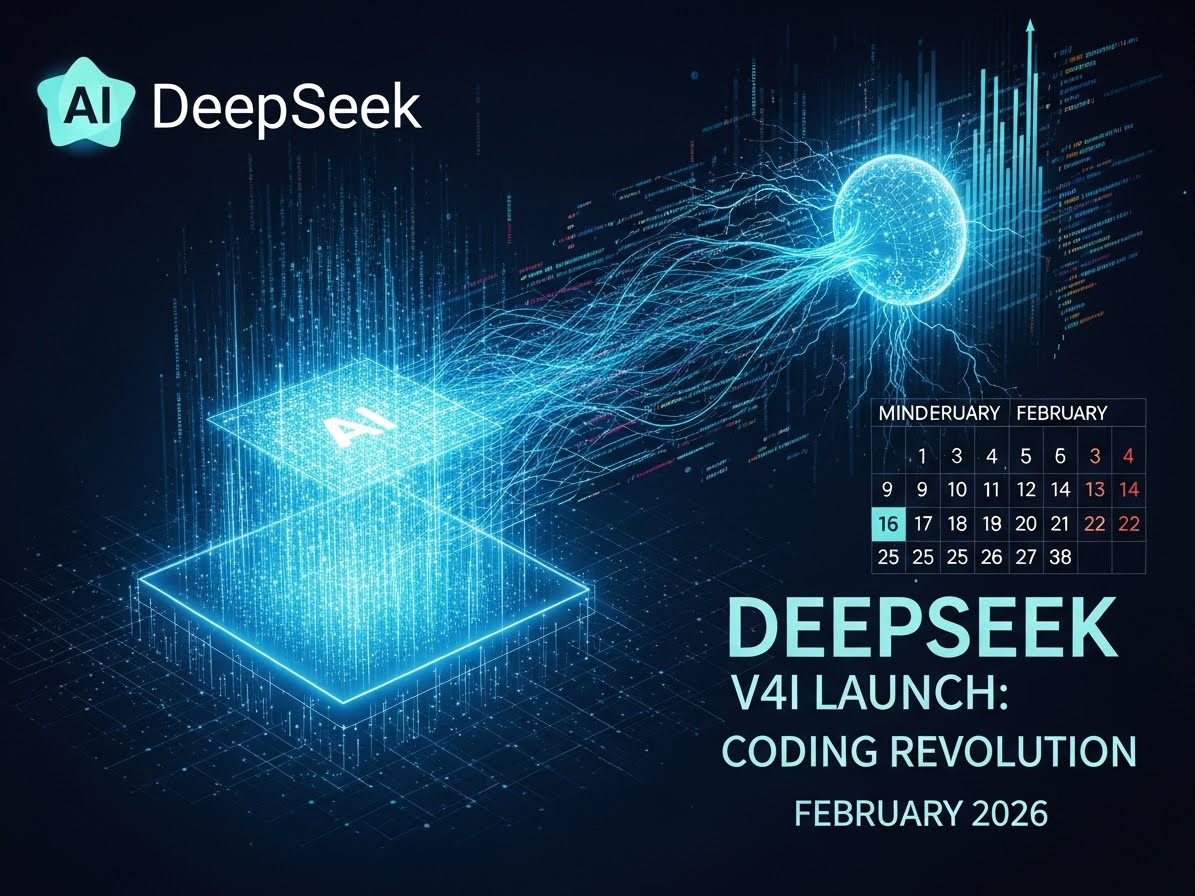
I've been following the AI startup scene for a while now, and every time a new model drops, it's like watching the tech world hold its breath. The latest buzz? Chinese AI powerhouse DeepSeek is gearing up to unleash its next-generation V4 model in mid-February 2026, with a laser focus on coding capabilities that could shake up the industry. According to a report from The Information published on January 9, 2026, citing sources familiar with the matter, this isn't just another incremental update – it's a model designed to tackle complex coding tasks with unprecedented efficiency. As someone who's tinkered with AI for coding side projects (like automating scripts for my content workflow), this news has me excited. Could V4 finally bridge the gap between human developers and AI assistants? Let's dig into the details from the report, what it means for the AI landscape, and why this launch could be a game-changer for programmers and creators alike. For the original story, head over to The Information's site at theinformation.com, where they break down exclusive insights like this.
DeepSeek, a Hangzhou-based startup that's quickly risen as China's answer to OpenAI, has been making waves with its previous models. Their DeepSeek-V3 and R1 releases in 2025 caught Silicon Valley's attention, with execs praising their efficiency and open-source approach. Now, V4 is poised to build on that, emphasizing "strong coding capabilities" that internal tests suggest could outperform heavyweights like Anthropic's Claude and OpenAI's GPT series in specific tasks. The timing – around mid-February, coinciding with the Lunar New Year – feels strategic, giving DeepSeek a cultural boost in China while grabbing global headlines.
But what exactly do we know so far? The report indicates V4 has made "breakthroughs in handling and processing extremely long coding prompts," a potential edge for developers working on intricate software projects. This could mean better support for large codebases, multi-language integration, or even automated debugging – areas where current models sometimes falter. If true, it's a big step toward AI becoming a true coding partner, not just a helper. DeepSeek's official website at deepseek.com hasn't confirmed details yet, but their track record of open-sourcing models (like V3 with 238B parameters) suggests V4 might follow suit, making it accessible for indie devs and researchers.
Why Coding-Focused AI Models Matter in 2026
The emphasis on coding isn't random – 2026 is shaping up as the year AI truly infiltrates software development. With global developer shortages (estimated at 4 million by Gartner), tools like V4 could accelerate code generation, testing, and maintenance. From my own experiments with GPT-4 for simple scripts, I know how time-saving it can be, but long prompts often lead to errors or incomplete outputs. If V4 nails that, it could reduce development time by 20-30%, per similar benchmarks from previous DeepSeek models.
For creators and non-coders like us in the AI art space, this has ripple effects. Better coding AI means faster tool updates – think Midjourney or Stable Diffusion getting smarter integrations for custom plugins. In India, where the IT sector employs millions, V4 could boost productivity in app development or automation, potentially adding $10 billion to the economy by 2027, according to McKinsey estimates. But it's not all rosy; concerns about job displacement loom, as AI handles more routine coding.
Internal Tests and Potential Performance: Outshining Claude and GPT?
The Information's sources claim internal DeepSeek tests show V4 surpassing Claude and GPT in coding benchmarks. While details are scarce, this aligns with DeepSeek's strength in open-source efficiency – their V3 model already topped leaderboards for cost-effective training. If V4 delivers on long-context coding (handling thousands of lines without losing track), it could excel in tasks like refactoring legacy code or generating full apps from specs.
Comparisons aren't apples-to-apples yet – Claude's strength is in safe, reasoned outputs, while GPT shines in versatility. V4's edge? Reportedly lower inference costs and faster processing, making it ideal for edge devices. For devs, this means cheaper, quicker iterations – a boon for startups. Check out Hugging Face at huggingface.co for similar open models to test against; it's a great platform for benchmarking.
The Launch Timeline and Strategic Angle
Mid-February 2026 – around Lunar New Year – isn't coincidental. DeepSeek's past launches (like R1 before 2025's holiday) timed for maximum visibility. Expect an open-source release shortly after, following their pattern. This could pressure competitors like OpenAI (visit openai.com for their latest) to accelerate coding-focused updates, sparking a mini-arms race.
Globally, it's a nod to China's AI ambitions – DeepSeek's backed by state investments, aiming to reduce reliance on Western tech. For users in restricted regions, this means more accessible alternatives.
Implications for Developers, Creators, and the AI Ecosystem
For developers, V4 could be a productivity rocket – automating boilerplate code or debugging complex systems. Creators like us in AI art might see indirect benefits: Better coding AI means faster tool evolutions, like automated prompt engines for Midjourney.
But challenges remain: Ethical use (avoiding code plagiarism), bias in training data, and integration hurdles. DeepSeek's transparency will be key – if V4's open-source, it could foster community improvements.
As 2026 unfolds, V4's launch feels like a milestone in AI's coding era. I'm optimistic – if it delivers, my script automation could get a serious upgrade.
What's your take on AI coding models? Excited for V4? Comment below. Subscribe for more AI news.
Based on The Information's Jan 9, 2026 report and DeepSeek's history. Views my own.
Frequently Asked Questions (FAQs):
- What is DeepSeek's V4 AI model? V4 is DeepSeek's next-generation AI model focused on advanced coding, with breakthroughs in handling long prompts.
- When is DeepSeek V4 launching? Mid-February 2026, around the Lunar New Year, according to The Information's report.
- How does DeepSeek V4 compare to Claude and GPT? Internal tests suggest V4 outperforms in coding tasks, but public benchmarks are needed for confirmation.
- Is DeepSeek V4 open-source? Previous models were; V4 is expected to be, but details are pending.
- What are DeepSeek V4's key features? Strong coding capabilities and improved long-context processing for complex development tasks.
- How will V4 impact developers? It could accelerate code generation, debugging, and project management, boosting productivity.
- Where can I learn more about DeepSeek? Visit DeepSeek's official website at deepseek.com for updates and previous models.