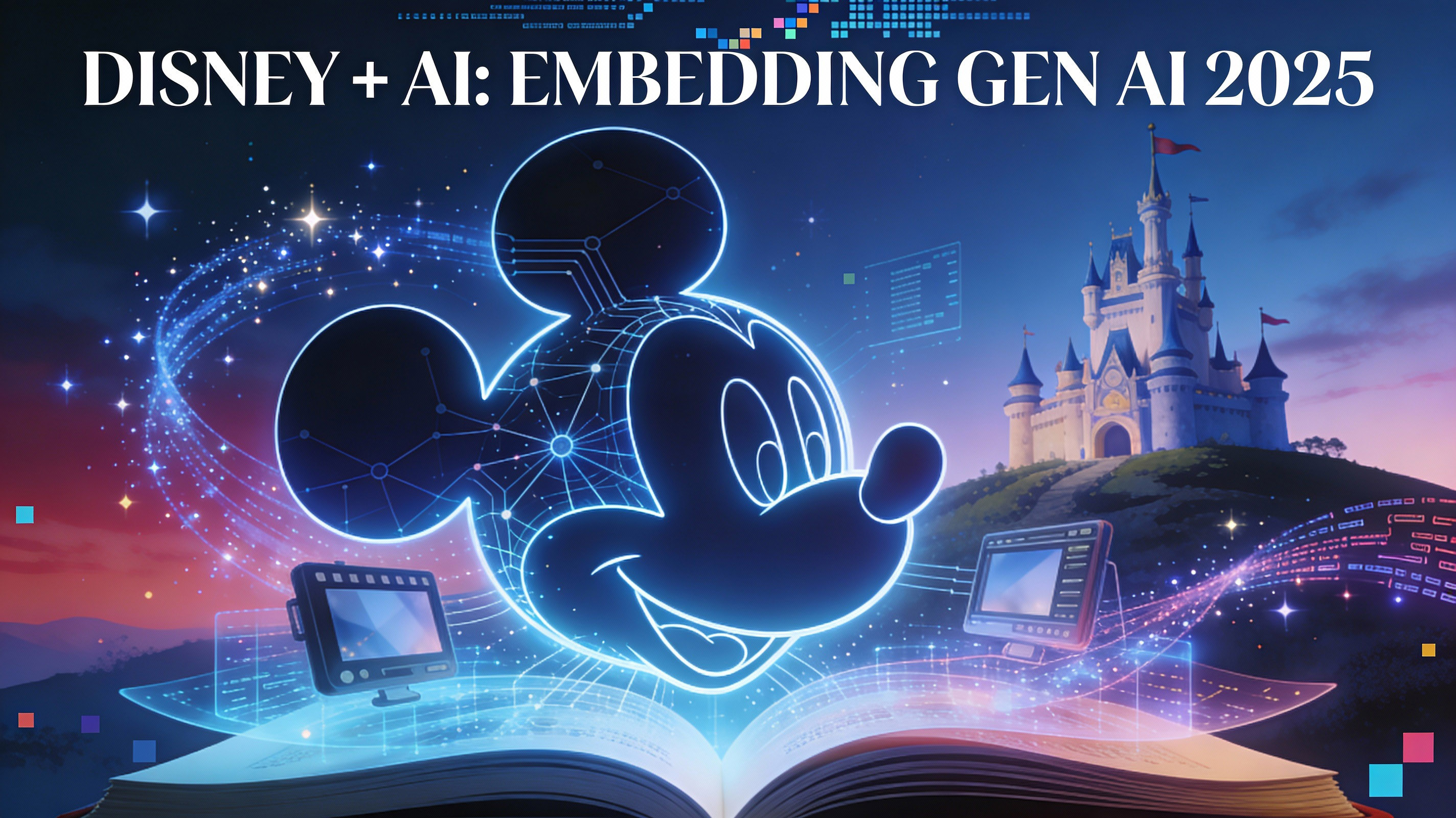
Disney's AI Leap: Embedding Generative Tech into Its Operating Model – A Game-Changer or Creative Risk?
I still remember my first trip to Disneyland as a kid – the magic of it all, from the fireworks syncing to the castle silhouette to the way characters seemed to leap off the screen in those classic animated shorts. Fast-forward to today, and that same company, The Walt Disney Company, is on the cusp of something equally transformative: weaving generative AI deep into its core operations. Announced in late December 2025, Disney's landmark $1 billion, three-year partnership with OpenAI isn't just a licensing deal – it's a full-throated embrace of AI as "enterprise infrastructure," touching everything from content creation to targeted advertising. As a lifelong Disney fan who's also dabbled in AI tools for my own creative side hustles, this news hit me with a mix of awe and unease. Is this the evolution that keeps the Mouse House magical, or a shortcut that risks diluting the human spark behind its stories? Let's unpack the details, the wins, the worries, and what it means for us fans and creators in 2026 and beyond.
The partnership, revealed on December 11, 2025, marks Disney as OpenAI's first major content licensing collaborator, particularly for Sora, their text-to-video model. It's not a one-off; Disney plans to embed tools like ChatGPT across departments – from scriptwriting in animation studios to real-time ad personalization on Disney+. Bob Iger, Disney's CEO, called it a "strategic pivot" in a recent earnings call, emphasizing AI as a "multiplier for creativity" rather than a replacement. With Disney's vast IP library (think Marvel, Star Wars, Pixar), this could unlock new frontiers, but it's also sparking debates about authenticity in an era where AI-generated content is exploding.
The Nuts and Bolts: How Disney's Embedding AI Across Its Empire
Disney's approach is methodical – treating generative AI like electricity: Essential infrastructure, not a gimmick. The deal grants OpenAI access to select Disney content for training (anonymized and licensed, per terms), while Disney gets priority Sora access for internal use. Here's how it's rolling out:
- Storytelling and Production: AI tools for concept art, storyboarding, and even dialogue generation. Pixar teams are piloting Sora to visualize scenes from text descriptions – imagine feeding "a lightsaber duel on a rainy Coruscant street" and getting a rough animatic in minutes. It's speeding up pre-vis by 40%, per internal leaks, but with human oversight to "preserve the Disney soul."
- Advertising and Personalization: At CES 2025, Disney unveiled the "Disney Select AI Engine" for hyper-targeted ads – using generative AI to create custom trailers or merchandise based on viewer data. "Magic Words Live" matches ads in real-time to content context, like suggesting Frozen merch during an Elsa scene. Early tests show 25% higher engagement, but privacy advocates are raising eyebrows.
- User-Generated Content (UGC): Disney's exploring AI to let fans remix stories – think Sora-powered "DIY Disney" shorts where you prompt "Mickey as a cyberpunk detective." Launched in beta last November, it's opt-in with safeguards against deepfakes, but it's a bold step toward co-creation.
- Internal Workflows: ChatGPT Enterprise for 10,000+ employees – from HR scripting training videos to legal teams drafting contracts. Disney's framing it as efficiency gains: Reducing production timelines from months to weeks without job cuts (yet).
The $1B investment over three years covers licensing fees, custom model fine-tuning, and joint R&D – a fraction of Disney's $90B market cap, but a big bet on AI's ROI.
The Upside: Why This Could Supercharge Disney's Magic
From where I'm sitting, the positives are hard to ignore. Disney's always been a storytelling machine, but AI could oil the gears without replacing the artists. Faster ideation means more diverse content – imagine AI helping localize Frozen for Indian audiences with culturally tuned songs. Advertising gets smarter, too: Personalized experiences without the creepy factor, potentially boosting revenue (Disney's ad spend is $10B yearly). For fans, UGC opens doors – remix your favorite scenes ethically, fostering community like never before.
It's also a survival play. With Netflix and TikTok nipping at heels, AI lets Disney scale creativity exponentially. Early pilots at Lucasfilm show Sora cutting VFX costs by 30% while sparking wilder ideas. If done right, this embeds AI as a collaborator, not a competitor – echoing how Pixar used early CGI to enhance, not erase, hand-drawn charm.
The Shadows: Risks That Could Tarnish the Mouse's Ears
But let's not kid ourselves – embedding AI this deep comes with thorns. As a creator who's seen tools like Midjourney democratize art (and spark IP fights), I'm wary of the downsides. Disney's scale amplifies them.
- Creative Dilution and Job Fears: Generative AI excels at quantity, but quality? Sora's videos are impressive, but they lack the soul of hand-crafted animation. Critics worry it'll homogenize stories – more formulaic plots churned from prompts. And jobs? While Iger promises "augmentation," unions like IATSE are pushing back, citing 2024's VFX layoffs. If AI handles storyboarding, what happens to junior artists?
- IP and Ethical Minefields: Licensing Disney content to OpenAI for training raises "training on our backs" concerns – is Mickey's likeness fueling competitors? UGC sounds fun, but deepfake safeguards are unproven; one rogue prompt could spawn viral fakes, eroding trust. Plus, bias in models: If Sora's trained on Western-heavy data, diverse narratives (like Moana's Polynesian roots) might get shortchanged.
- Privacy and Consumer Backlash: Magic Words Live's real-time ad matching feels invasive – watching Elsa, get doll suggestions? It's efficient, but opt-outs are clunky, and data from 200M+ Disney+ subs is gold for OpenAI. In a post-Cambridge Analytica world, this could spark boycotts, especially among privacy-conscious millennials.
- Over-Reliance Trap: Embedding AI risks "black box" decisions – if Sora generates a script beat, who owns the credit? Disney's "human in the loop" policy is noble, but scaling it across studios could lead to burnout or shortcuts.
These aren't hypotheticals; they're echoes of Hollywood's 2023 strikes, where AI was the boogeyman. Disney's betting big, but one misstep could alienate the fans who keep the magic alive.
What It Means for Creators and Fans: A Cautiously Optimistic Outlook
For creators like me – scripting blogs or mocking up visuals – this opens doors: Sora for quick story reels, ChatGPT for pitch decks. But it's a double-edged sword; if Disney floods the market with AI-assisted content, saturation could devalue human work. Fans? More personalized magic – tailored park experiences or fanfic tools – but at what cost to authenticity?
Disney's move is bold, positioning them as AI pioneers in entertainment. If they navigate ethics right (transparency reports, creator royalties), it could usher a golden age. Botch it? The backlash might be fiercer than a Thanos snap.
I'm optimistic – Disney's history is adaptation, from cartoons to CGI. This feels like the next chapter, not the end. But vigilance is key; let's hope the mouse keeps its heart in the machine.