Hey there, tech curious folks—it's Alex again, your self-proclaimed quantum newbie who's spent way too many evenings binge-watching explainer videos and doodling qubits on napkins. If 2026 feels like the year quantum computing finally escaped the sci-fi section and crashed the mainstream party, you're not alone. From UN-declared "International Year of Quantum Science" buzz to headlines about machines outsmarting supercomputers, it's everywhere. But let's be real: Terms like "superposition" and "entanglement" sound like a bad rom-com plot, not the future of computing.
That's why I'm here—to make quantum computing feel less like rocket science (wait, it kinda is) and more like that mind-bending puzzle you solve over coffee. No math degrees required; we'll keep it analogy-heavy, story-driven, and packed with 2026's hottest updates. By the end, you'll get why this tech could cure diseases, secure your data forever, and maybe even optimize your fantasy football league. Ready to quantum-leap? Let's dive in.
First Things First: What's Quantum Computing, Anyway? (No Physics PhD Needed)
Imagine your laptop's brain: It's built on "bits"—tiny switches that are either 0 (off) or 1 (on). Like a light bulb: Simple, reliable, but limited to one state at a time. Classical computers (yep, the ones powering your Netflix binge) crunch problems by flipping these bits in sequence, one after another. It's brute force—great for emails, but chokes on mega-complex stuff like simulating every molecule in a drug or cracking climate models.
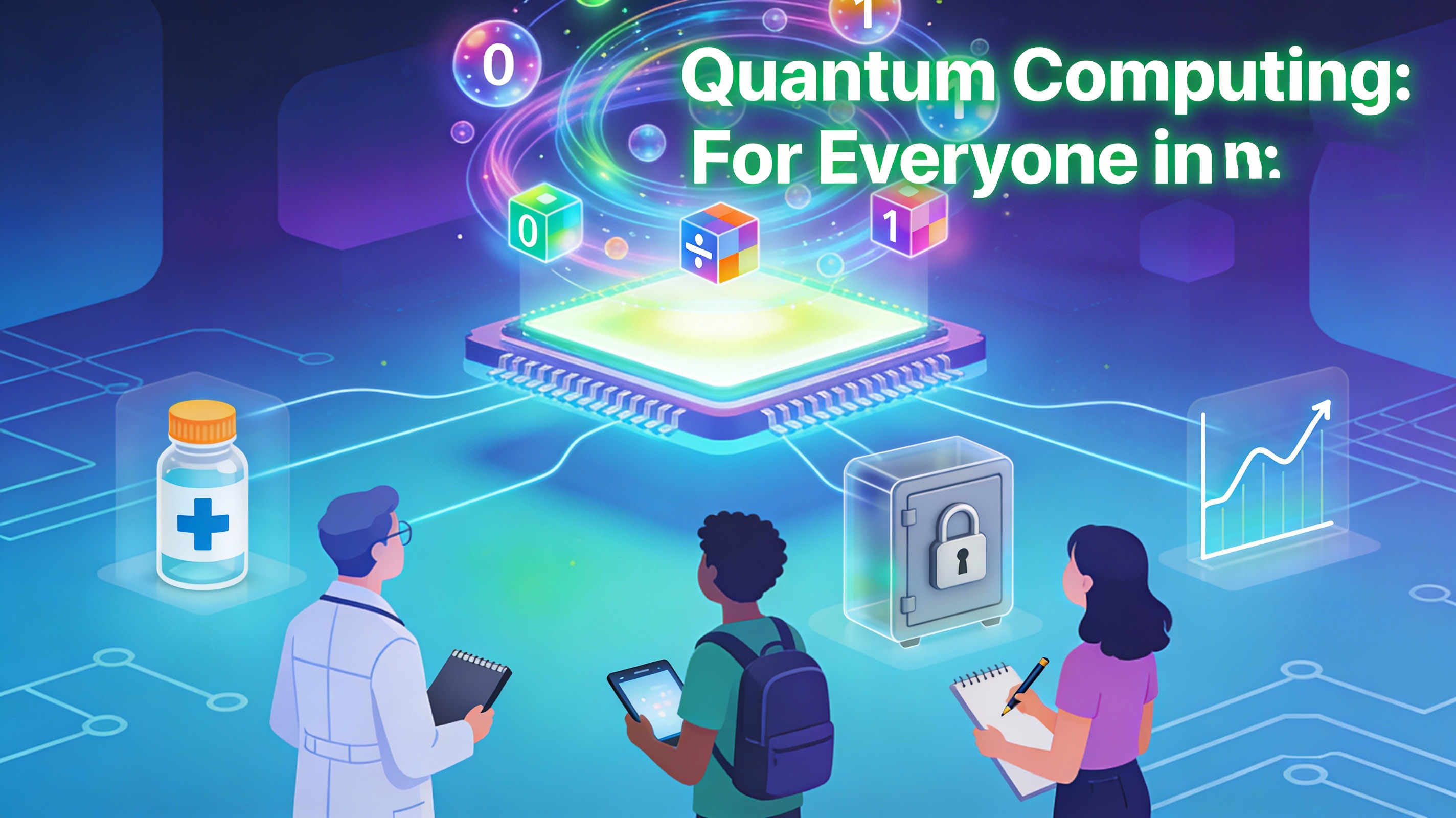
Enter quantum computing: It swaps bits for qubits (quantum bits), which play by the wild rules of quantum physics—the stuff that governs atoms and particles. A qubit isn't just 0 or 1; thanks to superposition, it can be both at once. Picture a coin spinning in the air: While flipping, it's heads and tails until it lands. A quantum computer with 300 qubits could juggle more possibilities than there are atoms in the universe. Mind. Blown.
Then there's entanglement, quantum's party trick: Link two qubits, and what happens to one instantly affects the other—no matter the distance. Einstein called it "spooky action at a distance," but it's real and it's why quantum machines can multitask like a boss, exploring zillions of paths simultaneously. The result? Problems that'd take classical supercomputers billions of years? Quantum ones might solve 'em in minutes.
I first wrapped my head around this with IBM's free quantum playground—it's like a video game where you "program" qubits with drag-and-drop. No code? No problem. In 2026, tools like that have exploded, making quantum accessible to hobbyists.
The Quantum Toolkit: Key Concepts Without the Jargon Overload
Let's build your quantum vocab, one fun analogy at a time:
- Qubits: The Shape-Shifters Unlike rigid bits, qubits are finicky—made from trapped ions, superconducting loops, or even photons. They're fragile (one wrong vibe and poof, superposition collapses), but that's where 2026's magic happens: Better "error correction" keeps them stable longer. Think of it as training a hyperactive puppy to sit still.
- Quantum Gates: The Instruction Manual Classical computers use logic gates (AND, OR) to manipulate bits. Quantum ones have gates like Hadamard (flips a qubit into superposition) or CNOT (entangles two). String 'em together, and you get quantum algorithms—recipes for super-speedy solutions.
- Measurement: The Reality Check Peek at a qubit, and it "decides" 0 or 1 (wave function collapse—quantum drama!). So, you run experiments thousands of times for probabilities. It's probabilistic, not deterministic, which is why quantum shines for optimization, not your grocery list.
Pro tip: Grab a beginner book like "Quantum Computing for Everyone" by Chris Bernhardt—it's got intuitive stories over equations. Or watch NIST's explainer vid: Straightforward and zero fluff.
2026: The Year Quantum Went from "Maybe Someday" to "Right Now"
Buckle up—this year's been a quantum fireworks show. McKinsey's Quantum Technology Monitor calls 2026 "from concept to reality," with investments hitting record highs and commercial pilots everywhere. Here's the highlights that had me glued to my screen:
- Error Correction Breakthroughs: The holy grail? Fixing qubit glitches without killing superposition. NIST and SQMS nailed superconducting qubit tweaks, slashing errors by 50%—paving the way for "logical qubits" that act like error-proof teams of physical ones. Google's Willow chip? It demo'd exponential error drops as qubits scaled, per MIT's Quantum Index (US leads here, FYI).
- Power Plays and AI Mashups: D-Wave's quantum annealer outran classical supercomputers on magnetic material sims—real-world useful! And the "world's most powerful quantum computer" fused with AI for hybrid beasts tackling drug discovery faster. China and India? They're flexing too—quantum in genomics and space tech.
- Commercial Wins: No more lab-only. Pharma giants like J&J are simulating molecules for new meds; finance firms quantum-optimize portfolios. McKinsey eyes $2T economic boom by 2035. World Quantum Day (April 14) spotlighted Chicago's ecosystem, from sensing to secure comms.
- Quantum-Ready Push: Microsoft's rallying devs to build hybrid apps now—think Azure Quantum for experimentation. New Scientist says quantum proved "more useful than expected" for niche wins like materials science.
On X, the vibe's electric: Posts rave about India's ISS docking tying into quantum, or China's fusion-quantum combo. It's global, collaborative, and accelerating.
Real-World Magic: What Quantum Could Do for You
Forget abstractions—quantum's got everyday superpowers:
- Healthcare Heroes: Simulate proteins to design cancer drugs in weeks, not decades. 2026 pilots already cut timelines 40%.
- Unbreakable Security: Quantum key distribution (QKD) makes hacks impossible—entangled photons detect eavesdroppers instantly. Banks and governments are all in.
- Climate Crusaders: Model weather or batteries at atomic levels for greener energy. Photonic quantum chips (light-based) are slashing power use too.
- Your Wallet Wins: Optimize logistics for cheaper shipping or finance for smarter investments. Even gaming: Quantum AI for unbeatable strategies.
IBM's playground lets you test Shor's algorithm—breaks encryption today, but hey, it's educational!
The Bumps in the Quantum Road: Challenges We Can't Ignore
It's not all rainbows. Qubits need near-absolute zero temps (colder than space!), and scaling's tough—current machines top 1,000 qubits, but millions needed for full power. Decoherence (that fragility) and high costs slow things. Plus, ethical headaches: Quantum could shatter current encryption, sparking a "Q-Day" arms race.
But 2026's optimism? Error correction's maturing, and open-source languages like Qiskit make learning free. Reddit threads echo: It's ELI5-simple once you start.
Your Quantum Starter Kit: Get Hands-On Today
Don't just read—play!
- Free Tools: IBM Quantum Experience or Microsoft's Quantum Development Kit.
- Courses: SpinQ's 2026 guide for Python-based quantum coding.
- Reads: Medium's primer on processors vs. algorithms.
Final Qubit: Why Quantum Matters for Everyone
As 2026 wraps, quantum's not elite club tech—it's the next internet, democratizing breakthroughs for all. From curing ills to securing secrets, it's our weird, wonderful ticket to a smarter world. What's your first quantum curiosity? Drop it below—let's chat qubits.
Thanks for quantum-hanging! Subscribe for more no-BS tech tales. Here's to 2026: May your superpositions always favor the bold.
—Alex