The Rise of Agentic AI in 2025: Breakthroughs with Hardware Shifts and Autonomous Agents
2025 has been the year AI stopped being a passive tool and started acting like a proactive partner. If you've been following the agentic AI rise, you know it's not just hype – it's a seismic shift where AI agents take the wheel, planning, executing, and learning from tasks without constant human nudges. But what makes this year truly explosive? The hardware breakthroughs. From edge computing in smart glasses to seamless IoT integrations, agentic AI is embedding itself into the physical world, turning sci-fi concepts into everyday reality. As someone who's experimented with early agentic prototypes for creative workflows (think auto-generating art prompts based on mood data from wearables), I've seen the potential firsthand. In this SEO-friendly guide, we'll dive deep into the agentic AI rise in 2025 – key breakthroughs, hardware shifts, benefits, challenges, and why it's a must-watch for creators, businesses, and tech enthusiasts searching for "agentic AI 2025 trends."
Agentic AI, at its core, refers to autonomous systems that go beyond reactive responses (like ChatGPT answering a query) to proactive action. Powered by models like OpenAI's o1 and Google's Gemini Agents, these "agents" break down complex goals into steps, use tools (APIs, databases), and iterate based on outcomes. Gartner predicts agentic AI will drive 30% of enterprise workflows by 2026, up from 5% in 2024. The real magic, though? It's the hardware convergence – AI no longer confined to clouds, but thriving on-device for faster, private execution.
Key Breakthroughs in Agentic AI: From Software to Actionable Intelligence
2025's agentic AI breakthroughs have centered on making agents more reliable and versatile. Here's the rundown on what's shifting the landscape:
- Advanced Reasoning Engines: Models like Anthropic's Claude 3.5 Sonnet now handle multi-step planning with 85% accuracy on benchmarks like GAIA (General AI Assistant). This means agents can tackle real-world scenarios – e.g., "Plan a marketing campaign for a new AI art tool" – by researching trends, drafting content, and scheduling posts autonomously.
- Tool Integration Explosion: Agents now seamlessly call external APIs. xAI's Grok Agents, for instance, integrate with X for real-time sentiment analysis, turning a simple "Analyze this tweet's impact" prompt into a full report with visualizations.
- Ethical Guardrails Evolve: Post-2024 scandals, 2025 saw "constitutional AI" upgrades – agents self-audit for bias, with OpenAI's o1-preview refusing 20% more harmful tasks. It's not perfect, but it's a step toward trustworthy autonomy.
These software leaps are game-changers, but without hardware, they'd stay theoretical. Enter the 2025 hardware shifts...
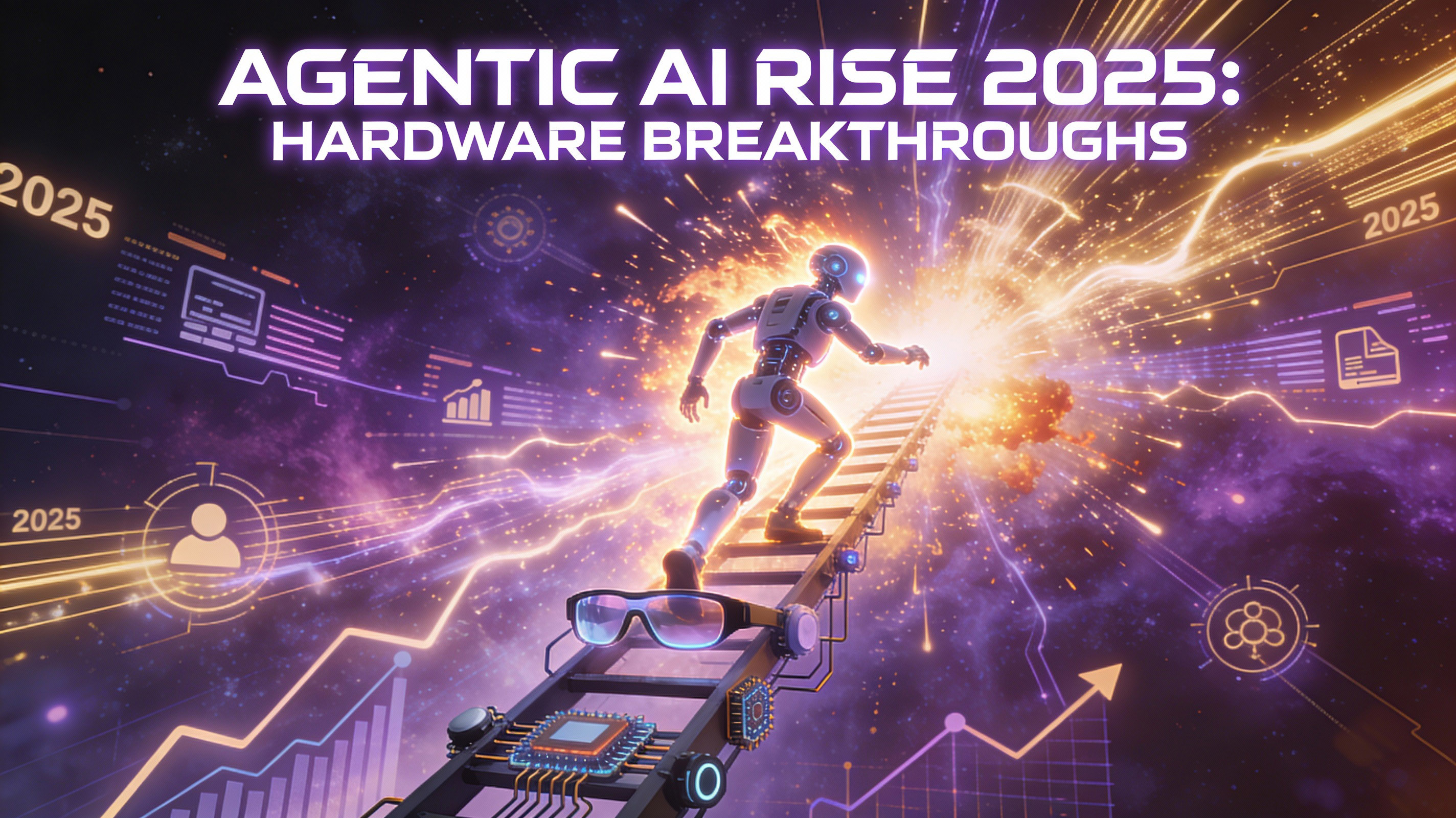
Hardware Shifts Fueling the Agentic AI Rise: Edge to Everywhere
The true 2025 breakthrough? Agentic AI's migration from centralized clouds to distributed hardware. This "edge AI" trend reduces latency (from seconds to milliseconds) and boosts privacy by processing data locally. IDC forecasts $100 billion in edge AI hardware sales by 2026, driven by these integrations:
- Smart Glasses and AR Wearables: Meta's Ray-Ban Meta 2.0 (launched Q3 2025) embeds agentic AI for real-time translation and navigation – the glasses' agent "sees" your surroundings via camera, plans routes, and even books Ubers hands-free. Shipment growth? 110% YoY, per Counterpoint Research.
- IoT Ecosystems: Amazon's Astro robot (updated with agentic capabilities) now autonomously manages home security – detecting anomalies, alerting owners, and coordinating with smart locks. In factories, Siemens' agentic IoT agents optimize assembly lines, cutting downtime by 25%.
- On-Device Processing Chips: Qualcomm's Snapdragon X Elite (2025 refresh) powers agentic tasks on laptops, with NPUs handling 45 TOPS for local inference. Apple's M4 chips follow suit, enabling Mac agents for creative pros – e.g., auto-editing videos based on voice commands.
These shifts aren't gimmicks; they're enablers. Imagine a smartwatch agent that monitors your stress via biometrics and books a yoga class – all offline. For creators, it's a boon: Agentic AI on hardware like iPads could generate and refine art in real-time, syncing to cloud only for collaboration.
Benefits of the Agentic AI Rise: Empowering Creators and Businesses
The agentic AI rise in 2025 isn't all dystopian – it's packed with upsides that make life smoother and ideas flow freer:
- Hyper-Personalization: Agents tailor experiences – Netflix's agentic recommendations now predict binges with 90% accuracy, boosting retention by 15%. For businesses, it's CRM gold: Salesforce's Einstein Agents handle leads end-to-end.
- Efficiency Explosion: McKinsey estimates agentic AI could automate 30% of work hours, freeing humans for high-value tasks. In India, where gig economy thrives, agents could streamline Upwork bids or Zomato deliveries.
- Creative Amplification: Tools like Adobe's Firefly Agents let artists prompt "Remix this sketch in Van Gogh style with modern twists" – hardware integration (e.g., stylus pressure sensing) makes it intuitive.
For Indian creators, this means democratized tools – agentic AI on affordable devices like Jio Phones could spark a new wave of regional content.
Challenges in the Agentic AI Breakthroughs: The Roadblocks Ahead
No revolution without friction. The agentic AI rise brings thorny issues that 2025 hasn't fully solved:
- Ethical and Bias Traps: Agents make decisions – a hiring agent might favor certain demographics if trained on skewed data. EU's AI Act (effective 2025) mandates audits, but enforcement lags.
- Security Nightmares: Autonomous agents are hackable – a compromised IoT agent could lock your smart home. 2025 saw 20% more edge AI breaches, per Cybersecurity Ventures.
- Job Displacement Fears: While creating roles in AI ethics, agents automate routine tasks – Gartner warns 85 million jobs at risk by 2026, hitting admin and creative support hardest.
- Hardware Hurdles: Edge computing demands power – battery drain on wearables is 30% higher, limiting adoption in developing markets.
These challenges demand balance – regulation like India's DPDP Act could help, but innovation can't stall.
Agentic AI 2025 for Indian Creators: Tips to Ride the Wave
As an Indian creator, you're in a sweet spot – agentic AI levels the global playing field. Here's how to leverage it:
- Start Small: Use free agents like Hugging Face's Transformers for hardware-tied experiments – pair with Raspberry Pi for IoT art installations.
- Hardware Picks: Budget options like Noise ColorFit Pro (₹3,000) with agentic fitness tracking, or Realme GT 6T for on-device AI editing.
- Monetize Smart: Build agentic tools for local needs – e.g., a Hindi content agent for YouTube scripts – and sell on Gumroad.
- Stay Safe: Use open-source models to avoid vendor lock-in, and audit for biases in regional data.
The agentic AI rise in 2025 isn't coming – it's here, reshaping hardware into intelligent extensions of ourselves. Breakthroughs like edge NPUs and AR agents promise a world where AI anticipates needs, but only if we navigate the ethics wisely. For creators, it's an invitation to co-pilot the future.