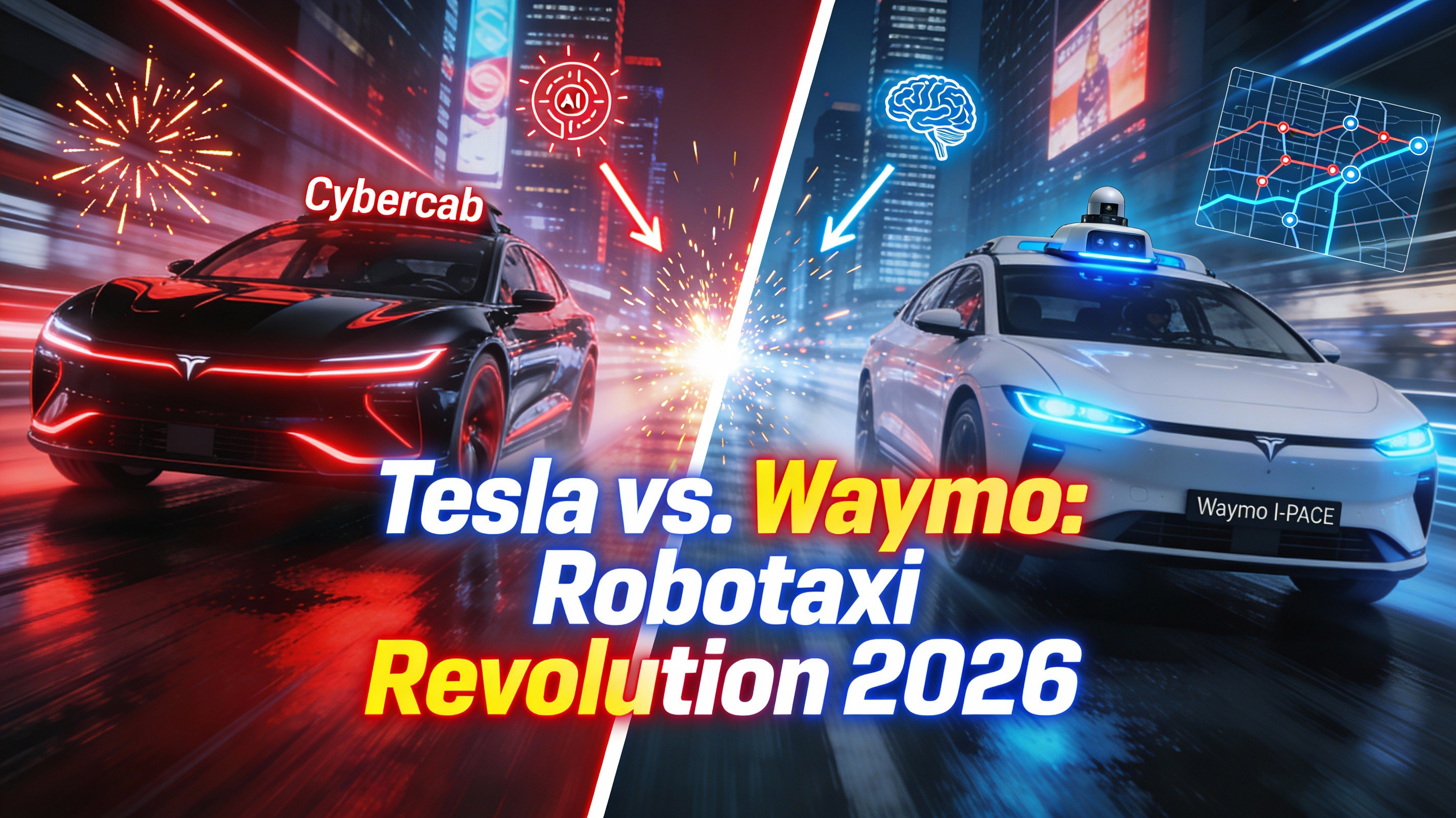
Hello, innovators and road warriors—it's the Team at The Vibgyor here, kicking off 2026 with the mobility story that's got the world gridlocked in anticipation. Picture this: Empty streets at rush hour, no honking horns, just silent pods whisking you from coffee run to conference call. That's the robotaxi dream, and after a decade of hype, it's slamming into reality harder than a Cybercab dodging traffic. But in this high-stakes race, two titans are duking it out: Tesla, the brash disruptor betting on vision-only AI and sheer scale, versus Waymo, the methodical pioneer with a decade of driverless miles under its belt.
We've crunched the data, scoured the streets (virtually, at least), and talked to the insiders buzzing on X. 2026 isn't just another year—it's the inflection point where robotaxis go from novelty to necessity, potentially slashing urban congestion by 30% and unlocking a $10 trillion mobility market by 2030. Tesla's Elon Musk promises a million unsupervised ridesharing vehicles by 2027, while Waymo eyes 20+ cities with its sixth-gen tech. But who's really leading the charge? Let's dissect the duel, from silicon to sidewalks.
The Starting Line: Where They Stand Heading into 2026
Waymo, Alphabet's moonshot darling, isn't new to this game—it's been ferrying paying passengers unsupervised since 2020, logging over 127 million miles by late 2025 with a safety record that's 90% cleaner than human drivers (0.02 serious crashes per million miles). As of January 2026, their fleet hums at around 2,500 vehicles—mostly Jaguar I-PACE SUVs retrofitted with lidar-heavy sensor suites—delivering 450,000 rides a week across Phoenix, San Francisco, Los Angeles, and Austin. It's not flawless: A December 2025 software outage grounded rides for hours, prompting faster update cycles and beefed-up emergency protocols. But Waymo's edge? Proven scalability and partnerships, like Uber for nationwide reach and Hyundai/Zeekr for next-gen hardware.
Tesla, meanwhile, is the underdog with swagger. Full Self-Driving (FSD) v14 rolled out supervised in 2025, boasting 7 billion miles of real-world data and claims of 7x fewer major incidents than the U.S. average. Yet, unsupervised robotaxi? Zilch in paid ops last year—despite Musk's October 2025 unveiling of the $30,000 Cybercab, a two-seater pod sans pedals or wheel. Wall Street's betting big anyway: TSLA closed 2025 near highs on robotaxi fever, with analysts like those at Investor's Business Daily calling 2026 the "defining year" if execution hits. X is split: Bulls predict Tesla "dwarfing Waymo" via volume, while bears mock the "euphoria" over unproven tech.
In short: Waymo's the tortoise—steady, sensor-stacked, and street-tested. Tesla's the hare—camera-only, data-hungry, and hell-bent on hare-speed scaling.
2026 Battle Plans: Rollouts, Tech, and Turf Wars
Waymo's playbook for the year? Aggressive expansion without the drama. They're swapping to the sixth-generation Waymo Driver—smarter, sleeker, and baked into Hyundai Ioniq 5s and Zeekr RTs for mass appeal—targeting 20+ U.S. cities by year-end, including Atlanta and more airports. Expect 6-7k vehicles humming, winter ops in snowy burbs, and deeper Uber ties for on-demand ubiquity. Yahoo Finance dubs it "Waymo's year," with rides potentially doubling to 1 million weekly as they chase profitability (currently at $0.50-$1 per mile, undercutting Uber's $2).
Tesla's counterpunch? A blitz from Austin. Production ramps in April on the Cybercab—induction-charging, AI-optimized for 5x cheaper rides ($0.20/mile target)—with unsupervised FSD v15 eyeing Q2 launches in Texas and California. Musk's bold: 1 million robotaxis in 50 cities by 2027, but 2026's the proving ground—starting with employee fleets, then public betas. The X factor? Tesla's vast data moat (from 6M+ owners) fueling end-to-end neural nets, potentially leapfrogging Waymo's modular stack. But regs loom: NHTSA probes into FSD crashes could delay nationwide green lights.
Head-to-head? Waymo wins on maturity (1,426 incidents cumulatively, mostly minor), Tesla on audacity (undercutting prices to "crush" competitors). Europe stirs too: Bolt's partnering Stellantis for 2026 debuts, eyeing Tesla's global shadow.
The Metrics That Matter: Safety, Scale, and the Bottom Line
| Category | Waymo (2026 Projection) | Tesla (2026 Projection) |
|---|---|---|
| Fleet Size | 6,000-7,000 vehicles | 20,000-50,000 Cybercabs (ramping from April) |
| Weekly Rides | 800,000-1M (20+ cities) | 500,000+ (Texas/California focus, scaling Q4) |
| Safety Record | 0.02 serious crashes/M mile (127M+ miles) | 7x better than humans (supervised; unsupervised TBD) |
| Cost per Mile | $0.50-$1 (profitable in core markets) | $0.20-$0.30 (disruptive pricing) |
| Tech Stack | Lidar + radar fusion, modular AI | Camera-only neural nets, end-to-end learning |
| Challenges | Scaling hardware costs, outage resilience | Regulatory hurdles, unsupervised validation |
Waymo's lead in unsupervised ops (15M paid rides in 2025 alone) gives it the safety halo, but Tesla's manufacturing muscle could flood markets by Q3, per Reddit futurists. X debates rage: "Tesla flips from car sales to rides, profiting where Waymo stalls." Yet, one Tesla glitch could headline-grab, while Waymo's "boring reliability" builds quiet loyalty.
Hurdles on the Horizon: Regs, Rivals, and Real-World Reckoning
No revolution without roadblocks. For Waymo: Winter weather tests (one serious 2026 incident could spark scrutiny), and rivals like Zoox (Amazon-backed, SF/Las Vegas launches) or Motional (Hyundai-Uber) nibbling at edges. Tesla? FSD v14's "unusable" beta flubs fuel skeptics, and zero unsupervised rides in 2025 leaves a proof gap. Globally, China's Baidu leads Asia, but U.S. turf (80% of AV investment) stays the arena.
The wildcard? Consumer trust. Surveys show 60% wary of driverless rides, but early adopters (Waymo's 450k weekly) prove the tide's turning. As Pueyo notes, Tesla's price war could "undercut both Uber and Waymo" by mid-year.
The Road Ahead: A Duopoly or a Free-for-All?
By December 2026, expect Waymo holding 40% U.S. market share in core cities, Tesla surging to 30% via viral scaling—potentially flipping the script by 2027. This isn't zero-sum; it's symbiotic—Waymo paves regulatory paths, Tesla floods with affordable EVs. The winner? You, with seamless, sub-$1/mile commutes reshaping cities.
What's your bet: Tesla's moonshot or Waymo's marathon? Share in the comments—we're all passengers on this ride.
—Team The Vibgyor